Voter ID on trial in Pennsylvania: the state abandons any appeal

Voting rights advocates have a victory to celebrate as the state of Pennsylvania has abandoned any appeal from the Commonwealth Court ruling striking down that states voter ID law as unconstitutional. Corbett says he won’t appeal voter ID law decision:
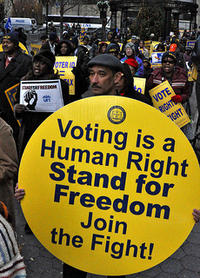
Voting-RightsGov. Tom Corbett put another nail in the coffin of Pennsylvania’s voter identification law on Thursday, announcing he would not appeal a judge’s decision that the law violated the fundamental right to vote.

The Republican governor issued a statement that defended the law, but he also said it needed changes and that he hoped to work with the Legislature on them.

“It is clear that the requirement of photo identification is constitutionally permissible,” he said. “However, the court also made clear that in order for a voter identification law to be found constitutional, changes must be made to address accessibility to photo identifications.”

The centerpiece of the law – a requirement that nearly all of the state’s 8.2 million voters show photo ID at the polls – was declared unconstitutional in January by a Commonwealth Court judge who said it imposed an unreasonable burden on the right to vote and that supporters had failed to demonstrate a need for it.

Read more

Kansas Judge rejects stay order in Arizona’s proof-of-citizenship voter registration case (Updated)

It appears U.S. District Judge Eric Melgren entered his order after I posted this Update on status of Arizona’s proof-of-citizenship voter registration case yesterday.

The AP reports Judge refuses to halt order over voter citizenship:

NoVoteVoters in Kansas and Arizona will have to provide proof of their U.S. citizenship when registering to vote using the federal form even as a U.S. agency appeals a federal judge’s order that helps those states enforce their voter registration requirements, the judge ruled Wednesday.

U.S. District Eric Melgren rejected the requests from the U.S. Election Assistance Commission and voting rights groups to put his earlier ruling on hold while the case goes to the 10th U.S. Circuit Court of Appeals. Melgren ruled on March 19 that the commission must immediately modify a national voter registration form to add special instructions for Arizona and Kansas residents about those states’ proof-of-citizenship requirements.

Read more

WaPo editorial: Fix the Voting Rights Act

The op-ed page  of our sad small town newspaper the Arizona Daily Star is essentially a copy and paste job from the Washington Post, so it is an interesting exercise of editorial discretion that the Star did not copy and paste this WaPo editorial calling on Congress to reauthorize the Voting Rights Act this year. Voting Rights Act fixes should get a vote in the House and Senate:

Voting-RightsLast year, the Supreme Court hollowed out one of the most powerful parts of the law, a formula prescribing which states and localities had to get before-the-fact federal approval of any changes they wanted to make to their voting rules. Without the formula, which had been based on historical records of discrimination, the federal government had to stop its automatic review of alterations to voting-district boundaries and other election-related guidelines. The ruling hobbled a law that for decades has offered meaningful political representation to minority Americans by preventing discriminatory tricks from limiting their access to the franchise. The decision was also an insult to Congress, which in 2006 overwhelmingly determined that the act’s provisions — all of them — remain necessary.

The only consolation is that the court did not bar lawmakers from creating a new pre-clearance coverage formula. All Congress has to do, in other words, is get its act together and fill the gap the court tore in the law. A bipartisan group of lawmakers has been trying. In the House, F. James Sensenbrenner Jr. (R-Wis.), who oversaw the 2006 reauthorization of the act, has led the effort, helping to draft a sensible compromise. The proposal, which has a score of co-sponsors, would require federal supervision of any place with five voting rights violations of various sorts over a rolling time frame of 15 years.

Read more

Update on status of Arizona’s proof-of-citizenship voter registration case

I attended a recent presentation by Pima County Recorder F.Ann Rodriguez and the staff of the Pima County Elections Division discussing how they are addressing changes in Arizona law for the upcoming election.

NoVoteI learned that Arizona Secretary of State Ken “Birther” Bennett is going forward with his Tenther “states rights” plan to bifurcate ballots between those voters who registered to vote using the state of Arizona’s voter registration form which requires proof of citizenship, and those who registered to vote using the federal National Voter Registration form which does not require the state proof of citizenship. Such a system would limit those who registered to vote using the federal form to only being allowed to vote for members of Congress this year — you would not be allowed to vote for any other office.

You may recall that the federal District Court for Kansas ordered back in March that the U.S. Elections Assistance Commission (EAC) immediately modify the National Voter Registration form to add special instructions for Arizona and Kansas residents about those states’ proof-of-citizenship requirements.

Read more

Bathroom Politics: Preserving the Sanctity of the ‘Ladies’ Room’

"Joan" from Mad Men primping in the Ladies Room.
“Joan” from Mad Men primping in the Ladies’ Room.

In the 1950s the Ladies’ Room was a place of refuge, a wall-papered lounge with a couch, polished mirrors, fresh flowers, and often an attendant armed with fresh towels, perfume, and mints. As men have always suspected, we didn’t go there just to use the facilities; the Ladies’ Room was a safe gathering place.

We went there to talk, to primp,  to smoke, to cry, to adjust a poor wardrobe choice, to sneak away from a bad dinner date, or just to sneak away. The Ladies’ Room was a place where women could be women–a place with no men watching, commenting, judging.

The Politicization of Bathrooms

In the early 1970s, at the height of the feminist era, “Ladies” Rooms came under fire. We feminists were not “ladies” who needed fainting couches in restrooms because we didn’t have the fortitude to work an 8-hour day without a nap or a good cry. “Ladies” were well-behaved women; we early feminists were anything but ladylike. As a result, “Ladies” Rooms became the Women’s Rooms– or Womyn’s Rooms– and the couches all but disappeared.

Further politicization of public bathrooms came later in the 1970s. I remember my first trip to a gay bar with a couple of gay guy friends, George and Henry. As professional photographers, the three of us worked together and played together. The Kismet, a legendary downtown Columbus gay bar, was hopping the night we were there– loud disco music, flashing lights, dancing, plenty of booze, and other adult entertainment and harder drugs, if you knew who to ask.

Read more