Something is rotten in the state of Wisconsin

I warned you the other day, “Something is rotten in the state of Wisconsin,” to paraphrase the Bard from Hamlet.

When corporations fund the campaigns of elected judges to the tune of hundreds of thousands of dollars, when those corporations appear before judges in Wisconsin they get the decisions that they paid for in advance.

I have previously posted:

dark_moneyNotably, the Wisconsin Supreme Court amended the state’s code of judicial conduct in 2010 to specifically exclude campaign contributions and independent expenditures as bases for recusal in Wisconsin.” BRIEF: Ethicists Urge Wisconsin Justices to Consider Recusal in Gov. Scott Walker Campaign Finance Case. This is in conflict with recent U.S. Supreme Court precedent:

The Brennan Center for Justice brief argues that the Wisconsin Supreme Court must consider the recusal motion in a manner consistent with the U.S. Supreme Court’s decision in Caperton v. A. T. Massey Coal Co. (.pdf), which ruled that judges may be required to recuse themselves when a litigant provides significant campaign support to a judge.

The state of Wisconsin has been so thoroughly corrupted since Citizens United and the rise of Scott Walker and the Tea Party, I no longer recognize the place I knew and loved. It’s like a dark mass insanity has overtaken a good part of its citizens.

Today the conservative groups that bankrolled Governor Scott Walker as well as the campaigns of the judges of the Wisconsin Supreme Court got the decision that they pad for in advance. Supreme Court ends John Doe probe that threatened Scott Walker’s presidential bid.
Read more

Voting Rights Act trial begins in North Carolina

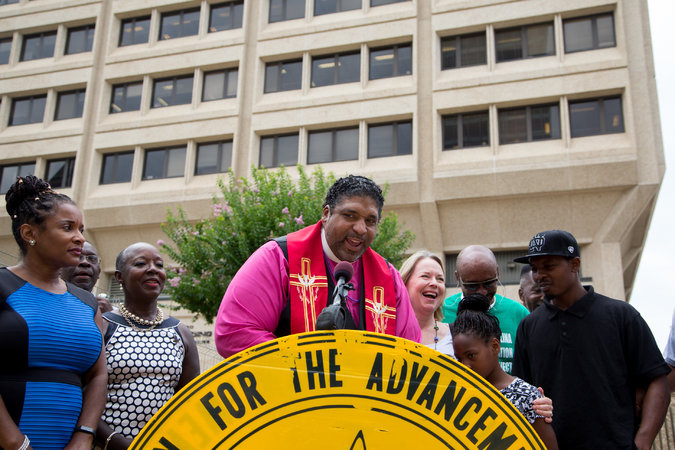
The New York Times has reporter Erik Eckholm in Winston-Salem, NC covering this Voting Right Act trial that opened on Monday. Sides Dispute Basis of North Carolina Voting Laws as Trial Contesting Them Opens:

WillimaBarberA trial over North Carolina’s voting laws opened in a federal courtroom here on Monday, with civil rights groups and the Justice Department arguing that the state had turned back the clock with sweeping changes to its election laws, while the state said the revisions applied equally to all and left its voting rules well within the national mainstream.

“The history of North Carolina is not on trial here,” said Butch Bowers, a lawyer representing Gov. Pat McCrory, in an opening statement. “We will show that there is no discrimination, intentional or otherwise.”

The plaintiffs in the case said the legislation, enacted in 2013, was deliberately drafted to reduce voting by African-Americans. They say the legacy of past racism in North Carolina, including the social and economic disparities between black and white citizens, is deeply relevant.

The contested measures reduced early voting days, ended same-day registration, ended out-of-precinct voting and halted the preregistration of 16- and 17-year-old high school students. These measures had been adopted in the past 15 years to increase voter participation and were disproportionately used by black, Hispanic and younger voters.

The Republican-dominated state legislature adopted the changes only weeks after the United States Supreme Court weakened the Voting Rights Act of 1965 when it ended a requirement that election changes in North Carolina and eight other states with a history of racial discrimination in voting be preapproved by federal officials or courts.

Read more

Wisconsin Supreme Court to rule on ‘John Doe’ cases on Thursday

Cartoon_22Scott Walker, “the goggle-eyed homunculus hired by Koch Industries to run their Midwest subsidiary formerly known as the state of Wisconsin,” announced that he is running for president on Monday. It looks like he may have to make a short week of it.

I have been reminding you that we are still waiting on the Wisconsin Supreme Court to rule in three cases that will determine whether the “John Doe” investigations into illegal campaign coordination, and separate but related criminal investigations initiated by Milwaukee County prosecutors, can be revived or must be ended for good. John Doe Investigations – Milwaukee Journal Sentinel.

The Wisconsin Supreme Court is now set to announce its rulings on Thursday. Wisconsin court to rule on John Doe probe’s validity:

The Wisconsin Supreme Court is set to rule Thursday on whether a secret probe can continue into whether Gov. Scott Walker’s 2012 recall campaign illegally coordinated with conservative groups.

Unnamed petitioners have filed two lawsuits seeking to halt the John Doe proceeding, Wisconsin’s version of a grand jury investigation where information is tightly controlled. Prosecutors have filed their own action seeking to reinstate quashed subpoenas in the probe. The high court is expected to rule in all three lawsuits.

Read more

George Will’s radical ‘litmus test’ for a return to the Lochner era

LOCHNER-final-600-3-221x300There is a revival of a long-discredited legal doctrine among conservatives, mostly among Libertarian lawyers, some of whom post at the Volohk Conspiracy, the Federalist Society, the so-called “Constitution in Exile movement,” and a book by David Bernstein, “Rehabilitating Lochner,”which argues that the U.S. Supreme Court decision in Lochner v. New York (1905) was correctly decided, and that the Lochner era never should have ended:

The Lochner era is a period in American legal history in which the Supreme Court of the United States made it a common practice “to strike down economic regulations adopted by a State based on the Court’s own notions of the most appropriate means for the State to implement its considered policies,” by using its interpretation of substantive due process to strike down laws held to be infringing on economic liberty or private contract rights.

* * *

Since the 1930s, Lochner has been widely discredited as a product of a “bygone era.” Robert Bork called Lochner “the symbol, indeed the quintessence, of judicial usurpation of power.” In his confirmation hearings to become Chief Justice, John Roberts said, “You go to a case like the Lochner case, you can read that opinion today and it’s quite clear that they’re not interpreting the law, they’re making the law,” concluding that the Lochner court substituted its own judgment for the legislature’s findings.

Read more

Corporate malfeasance and ‘disinformation’ campaigns, from tobacco to climate science

In 1994, Representative Henry Waxman (D-CA), Chairman of the House Committee on Energy and Commerce Subcommittee on Health and the Environment, subpoenaed the top executives of the seven largest U.S. tobacco companies and asked them to testify under oath whether they believed nicotine to be addictive.

Screenshot from 2015-07-12 14:12:37

All of the tobacco executives testified under oath that “I believe that nicotine is not addictive.” Tobacco CEO’s Statement to Congress.

The Waxman hearings represented the pinnacle of the tobacco industry’s decades long campaign to collude together to mislead the public by promoting “controvery” about the harmful effects of smoking and the addictiveness of nicotine.

Just four years later, the four largest U.S. tobacco companies entered into a “global settlement agreement,” i.e., the Tobacco Master Settlement Agreement, in which the attorneys general of 46 states settled their Medicaid lawsuits against the tobacco industry for recovery of their tobacco-related health-care costs — but also exempted the companies from private tort liability regarding harm caused by tobacco use. In exchange, the tobacco companies agreed to curtail or cease certain tobacco marketing practices, as well as to pay, in perpetuity, various annual payments to the states to compensate them for some of the medical costs of caring for persons with smoking-related illnesses.

History is repeating itself with the Carbon Monopoly’s decades long campaign to collude together to mislead the public by promoting “controvery” about the harmful effects of global warming and climate change. Think Progress reports, Oil Company Exxon Knew About The Scientific Reality Of Climate Change In 1981:

[T]he Union of Concerned Scientists has disclosed an email revealing that Exxon understood the scientific reality of climate change as far back as 1981. “Other companies, such as Mobil, only became aware of the issue in 1988, when it first became a political issue,” Exxon’s former in-house climate expert, chemical engineer Leonard S. Bernstein wrote last year. The 30-year veteran of Mobil and Exxon explained:

Exxon first got interested in climate change in 1981 because it was seeking to develop the Natuna gas field off Indonesia. This is an immense reserve of natural gas, but it is 70% CO2. That CO2 would have to be separated to make the natural gas usable.

And yet despite a growing understanding of the scientific reality of climate change in the 1980s and 1990s, Exxon became one of the biggest funders of scientists and think tanks and others who do little but deny and cast doubt on the scientific understanding of human-caused global warming.

Read more