(Update) Tom ‘banned for life by the SEC’ Horne, poster boy for political corruption

Tom “banned for life by the SEC” Horne is having a well-deserved really bad week. Now a formal complaint has been filed with the Maricopa County Attorney’s office. The Arizona Capitol Times (subscription required) reports Ex-Horne staffer files complaint with county attorney:
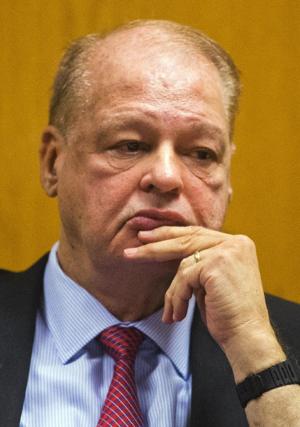
TomHorneThe attorney for a former Attorney General’s Office staffer who accused Tom Horne of using state resources and personnel to run his reelection campaign has filed a complaint with the Maricopa County Attorney’s Office.

MCAO spokesman Jerry Cobb confirmed that attorney Tom Ryan filed a complaint with the agency on Tuesday. Ryan represents Sarah Beattie, who worked in the attorney general’s constituent services division and volunteered as a fundraising consultant for Horne’s campaign before resigning in April.

Beattie on Monday filed complaints with the Secretary of State’s Office and Citizens Clean Elections Commission alleging that most members of Horne’s executive office staff conduct campaign activities during the work day, and that she spent the majority of her days at the Attorney General’s Office on campaign work.

While Beattie and Ryan alleged violations of two election-related statutes, the complaint also accused Horne and his staff of violating the “mini-Hatch Act,” Arizona’s version of a federal law that bars the use of public resources for political campaigns.

Cobb would not comment on the content of the complaint, nor would he say whether MCAO is investigating.

Read more

Gov. Brewer appeals decision giving our lawless legislature standing to proceed with Medicaid expansion lawsuit

gavelGov. Jan Brewer today filed an appeal to the Arizona Supreme Court seeking to overturn an appellate court ruling allowing legislators standing to proceed with a lawsuit against the hospital assessment that funds Brewer’s Medicaid (AHCCCS) expansion plan. The Arizona Capitol Times (subscription required) reports, Brewer appeals Medicaid ruling to Arizona Supreme Court:

Douglas Northup, Brewer’s attorney, argued that the Court of Appeals’ ruling that the 36 Republican lawmakers have standing to challenge the hospital assessment flies in the face of years of judicial precedent. The lawmakers are asking the court to referee a political dispute in which they ended up on the losing end, Northup wrote in the appeal.

The lawmakers argue that the hospital assessment is a tax that should have required a two-thirds vote in the Legislature under Proposition 108, a 1992 amendment to the Arizona Constitution that mandates a supermajority vote for all tax increases. The budget bill that contained the hospital assessment passed only with a simple majority.

Brewer said she is hopeful that the high court will accept her appeal.

Read more

Kansas and Arizona file response to request for stay in proof-of-citizenship voter registration case

Screenshot-15Tuesday was the deadline for the anti-immigrant Secretary of State of Kansas, Kris Kobach — the coauthor of Arizona’s Prop. 200 (2004) and SB 1070 (2010) — and Arizona’s Secretary of State, Ken “Birther” Bennett, to file their response to the U.S. Election Assistance Commission (EAC) and intervenor plaintiffs’ requests for a stay on appeal to the Tenth Circuit Court of Appeals. States claim right to require documents to vote:

The states of Kansas and Arizona say they have a sovereign right to require proof of citizenship for voting residents of their states, even for federal elections.

The two states urged the 10th Circuit Court of Appeals on Tuesday to lift the [temporary] emergency stay it issued last week. The appeals court had halted a ruling from U.S. District Judge Eric Melgren requiring the U.S. Election Assistance Commission to modify its federal voter registration form for Kansas and Arizona residents.

Kansas claims the appeals court stay would force it to implement a burdensome dual election system, like the one in Arizona.

Under that system, voters who registered with the federal form can only vote in federal races, while those using the more stringent state registration forms can vote in all elections.

This is a bit of misreporting. Kansas and Arizona have never had such a “dual election system.” The “dual election system” is a scheme being threatened to be implemented by Tenther “states’ rights” sovereign citizens Kris Kobach and Ken “Birther” Bennett in contravention of any permanent stay order which may be issued by the Tenth Circuit Court of Appeals on appeal — they are threatening to defy the federal courts, and to deny U.S. citizens their franchise to vote in violation of the privileges and immunities guaranteed to U.S. citizens by the 14th Amendment. This will only lead to more litigation, and if not quickly resolved by the courts, to confusion in voting  in this year’s election.

Read more

Idaho judge strikes down state’s same-sex marriage ban (update)

Lyle Denniston at SCOTUSblog.com reports, Idaho same-sex marriage ban nullified:

EqualA federal judge in Boise, ordering Idaho state and local officials to begin allowing same-sex couples to get married on Friday morning, struck down all laws in the state that permit or recognize only man-woman marriages.  A string of modern Supreme Court rulings, Chief Magistrate Judge Candy W. Dale said in a fifty-seven page ruling (.pdf), sent a message that was “unmistakable — all individuals have a fundamental right to marry.”

The judge said nothing in the ruling about a newly filed state request that she put on hold a ruling against the state ban.  (That request is discussed in an earlier post.)  Whether her ruling goes into effect on Friday at 9 a.m. local time (11 a.m. Eastern) may depend on the steps state officials now attempt to get it blocked — either by the U.S. Court of Appeals for the Ninth Circuit or by the Supreme Court.

Read more

Fourth Circuit panel divided on Virginia same-sex marriage ban (updates)

The Virginia same-sex marriage case of Bostic v. Schaefer was heard by a panel of the Fourth Circuit Court of Appeals today, which appeared to be sharply divided to courtroom observers.  The New York Times reports, Virginia’s Ban on Same-Sex Marriage Before Federal Panel:

EqualIn sharp exchanges pitting the right of states to set marriage rules against equal protection for gay and lesbian couples, a three-judge federal appeals panel here heard arguments (listen) Tuesday on the constitutionality of Virginia’s ban on same-sex marriages.

The panel of the United States Court of Appeals for the Fourth Circuit appeared to be divided on the issues in what legal experts consider a crucial case that could propel the marriage question to the Supreme Court in the coming year.

“Is this a constitutional issue of magnitude or a democratic issue that can be decided by the states?” asked the presiding judge, Paul V. Niemeyer, in one of several comments that seemed to suggest support for Virginia’s restrictive law.

A second judge, Roger L. Gregory, gave strong indications of support for equal treatment of gay and lesbian couples. As lawyers defended Virginia’s restrictions as a reasonable attempt to foster procreation and child welfare, Judge Gregory pressed them, asking “Do same-sex couples have children? Do you think that child wants less of the dignity of marriage than any other child?”

It appeared that the third panelist, Henry F. Floyd, who spoke relatively little, might provide the decisive vote. His few questions did, however, suggest support for overturning Virginia’s ban.

Read more