
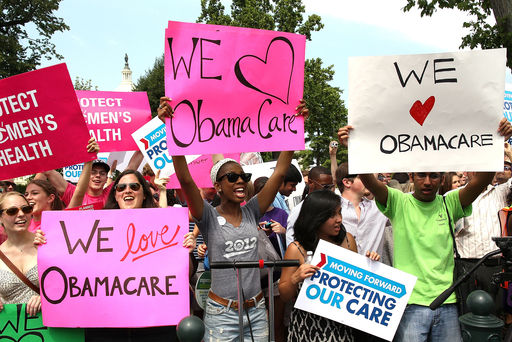
More good news from the Affordable Care Act aka “ObamaCare” — the ACA reforms applicable to Medicare are extending the solvency of the Medicare Trust. In an annual report today, Medicare finances improve as healthcare inflation slows, trustees say:
 Improvements in healthcare costs have extended the life of Medicare’s main trust fund by four years, the annual report of the Social Security and Medicare trustees said Monday, a further sign of the positive effect of lower medical inflation.
Medicare Part B premiums are expected to remain the same through 2015 because of that improvement, Health and Human Services Secretary Sylvia Burwell told reporters as the report was released.
Medicare is “considerably stronger than it was just four years ago,” she said.
[T]he longer life for Medicare’s Hospital Insurance trust fund, which is now projected to remain solvent through 2030, provides the latest evidence of how the slowdown in the growth of medical costs has improved government finances.
The cost per beneficiary for Medicare has remained flat for two years, noted Robert Reischauer, the former director of the Congressional Budget Office who serves as the system’s other public trustee. The projected size of Medicare’s long-term deficit relative to payrolls has been cut by more than one-third since the trustees’ 2012 report, he noted.
* * *
Lew and Burwell said President Obama’s healthcare law deserves some of the credit for the improvement in healthcare costs.
Sarah Kliff at Vox.com reports on The amazing news buried inside a 283-page Medicare report:
This is arguably the most unexpected piece of news in the new Medicare Trustees report: the government’s hospital insurance program might be spending less money to cover more beneficiaries than it did a year ago.
Medicare’s hospital insurance program — known to wonks as Medicare Part A — spent $266.8 billion covering 50.3 million people in 2012. In 2013, the the same program spent $266.2 billion to cover 51.9 million people. These figures come from Table II B.1 in the 2012 and 2013 reports.
* * *
[S]ome senior administration officials I spoke with cautioned against reading too much into these particular figures; receipts for services rendered in 2013, for example, might trickle after the year has ended.
But what’s definitely clear — and what’s driving this trend — is that Medicare is spending significantly less per person than they did two years ago. And this report expects that trend to continue for another two years going forward.
By 2015, the Medicare Trustees’ Report projects that the program will spend less per person on hospital care than it did in 2008. This doesn’t happen much in health care: not just slower growth, but the actual dollar amount spent on a given type of care dropping.
These figures only represent the hospital insurance part of Medicare (this is Medicare Part A). The government insurance program has separate programs for doctor visits (Medicare Part B) and prescription drug coverage (Medicare Part D).
But even when you look at the overall picture, it generally looks pretty good: per-person Medicare spending has grown by an average of 0.8 percent since 2009. That’s a lot slower than the rest of the economy, which has grown at an average 3.1 percent rate. Between 2012 and 2013, it was even slower: Medicare’s per person costs stayed exactly the same.
As Health and Human Services Secretary Sylvia Mathews Burwell put it at a press briefing today, “that is a growth rate of 0 percent.”
* * *
Its certainly possible that the overall economic climate might have impacted seniors’ decisions about health care. And its possible the health care law, and its changes to the Medicare system (this report estimates there are 165 of them) have had an impact as well.
* * *
Overall, this report suggests a pretty positive trend for Medicare spending — it just doesn’t totally explain the forces that are driving it.
Sarah Kliff also posts a timely reminder of something that I have posted about in the past: “No, Medicare is not going bankrupt” (something you hear from GOP candidates every election cycle). Medicare isn’t going bankrupt. This chart proves it:
There is exactly one chart you need to see to understand that hand-wringing is pretty much unnecessary. Reports of Medicare’s death have been, as Mark Twain would put it, greatly exaggerated.
For decades now, the Trustees have published predictions on when Medicare would run out of money if nothing else in the world changed. And in every case, lots of things in the world changed — and Medicare never found itself short on funds. The Congressional Research Service tallied up the old projections in a 2009 report, which I used to create the table below.
What you’ll see here is that this report has predicted, many times in the past, that the Medicare Trust Fund would run out of money. But its never actually happened: each time the projected insolvency date gets close, there’s typically a pattern where Congress steps in and passes some type of policy to make trust fund dollars stretch at least a decade longer.
At its core, the Medicare Trust Fund is an accounting mechanism. It’s where payroll taxes go to help finance the Medicare program — and its where the government-run insurance program draws funds to pay seniors’ hospital bills.
The projected date of insolvency speaks to a world where Congress never changes anything about Medicare, the world of health financing stays static, and, if we keep spending payroll tax dollars at current rates, the fund can’t pay its bills.
In other words, the date of projected insolvency speaks to a world that doesn’t really exist. Health financing isn’t static, and Congress has lots of tools in its legislative tool box to ensure Medicare can continue paying seniors’ bills. That’s what they’ve done in the past and, given that seniors are pretty big fans of Medicare (as well as pretty big fans of voting), its a decently safe assumption that its what they would do in the future, too.
Any time a candidate says to you that Medicare is going bankrupt, know that this damn fool is just lying to you as part of GOPropaganda “Mediscare” campaign tactics.
Discover more from Blog for Arizona
Subscribe to get the latest posts sent to your email.
Imperfect and all, the ACA continues to demonstrate short and long term value for the citizens of the USA. Without the benefit of legislative tweaking to make it even better.
Thus, I’m expecting that Tan Man, Weeper of the House, will call for another vote to repeal before Friday. Ya know – on their way out the door, so the Tea-Bagging Crew can be appeased during August recess.
And our Rabid Reeper Reps (Schweinhund, NOsar, Frankenstein, and Salmonella) will line up along with the most ineffective and despised House majority in American history.