Rigged elections: GOP voter suppression and the Voting Rights Act

The egomaniacal Twitter troll Donald Trump spent more than a year seeking to undermine American’s confidence in their electoral system, first claiming without evidence that the GOP primaries were rigged, then spending months claiming the general election was rigged. Trump falsely claimed without evidence that millions of illegal voters voted to explain losing the popular vote by well over 2 million votes.

Trump even suggested that his supporters might resort to “Second Amendment remedies” if the election did not go his way, Donald Trump Suggests ‘Second Amendment People’ Could Act Against Hillary Clinton, eschewing the American tradition of deciding elections by the ballot box, not bullets.

This is the man who is now in a position to impose GOP restrictions on voting in pursuit of the GOP’s mythical “voter fraud” fraud — in reality, voter suppression of Democratic-leaning voter constituencies. After Bitter Campaign, Election Positions Trump to Shape Rules on How You Vote:
Voting-RightsAfter an extraordinarily contentious election, crucial elements of the rules that determine how Americans vote will be under assault from conservatives and facing legal challenges heading toward the Supreme Court as Donald J. Trump prepares to become president.

Mr. Trump’s claims of a “rigged” election — made before he won — and his false declaration after his victory that “millions of people” had voted illegally for Hillary Clinton made headlines.

They also amplified longstanding Republican claims that rampant voter fraud justified a welter of state laws making it more difficult to register and vote. Democrats say the laws are not about combating fraud but about suppressing the vote of minorities and other Democratic-leaning constituencies.

Mr. Trump will have enormous power to shape future policy on voting.

Read more

SCOTUS stays 9th Circuit Court of Appeals injunction of Arizona ballot collection law

Amy Howe of SCOTUSblog reports Justices reinstate Arizona ban on “ballot harvesting” for election:

VotersOnly days before the November 8 election, an emergency application involving voting procedures was filed at the court – specifically, a challenge to an Arizona law, known as H.B. 2023, that makes it a felony for anyone other than election officials, mail carriers, family members, or caregivers to collect early voting ballots. [Saturday] morning the justices blocked (Order) the ruling by the U.S. Court of Appeals for the Ninth Circuit in favor of the challengers, thereby allowing the Arizona law to remain in effect in advance of Tuesday’s election.

* * *

Late yesterday afternoon, Arizona asked the Supreme Court to step in, reverse the en banc court’s “unprecedented and unsustainable order,” and allow the law to remain effect. It relied heavily on Purcell v. Gonzalez, a 2006 challenge to another Arizona voting law. Purcell, the state contended, suggests that, as an election draws nearer, courts should be more reluctant to order changes to voting laws, because of the possibility that doing so will cause voter confusion and incentives not to go to the polls. With only four days before the election, the state emphasizes, “emotions and rushed judgment typically have no place and should be avoided.”

Arizona adds that H.B. 2023 is hardly an outlier: twenty-six other states bar this kind of ballot “harvesting,” while thirteen other states make it a felony.

Read more

Updates on Arizona election law challenges (Updated)

Two of the legal challenges to Arizona election law that we reviewed yesterday now have a decision from the court. I’m still waiting on a third case.

The case to block Arizona’s ballot collection law: U.S. court blocks Arizona ban on groups collecting ballots:

Voters[The 9th Circuit Court of Appeals] has blocked an Arizona law making it a felony to collect early ballots, a win for the Democratic get-out-the-vote effort shortly before Election Day.

The order (.pdf) [granting the injunction based on the dissenting opinion from the 3 judge panel] from an 11-judge panel of the 9th U.S. Circuit Court of Appeals means it won’t be a crime for groups to go door to door to collect early ballots from voters and deliver them to the polls. It’s a tactic especially effective in minority communities.

The en banc 9th Circuit panel said it was preserving the status quo for this election and set a full hearing for January on the Democrats’ request to permanently block the law. (The en banc hearing for oral argument is scheduled for January 17, 2017, in San Francisco).

Read more

Updates on Arizona election law challenges

The 9th Circuit Court of Appeals has agreed to hear en banc an appeal from the decision of a three judge panel of the court last week in Feldman v. Arizona, upholding Arizona’s new law prohibiting ballot collection. There was a concurrence by Judge Reinhardt and a dissent by Judge O’Scannlain. (The dissent cites the Purcell principle against taking the case. so close to the election.)

The Arizona Capitol Times (subscription required) reports, Full appeals court to review ‘ballot harvesting’ law:

Voting-RightsFederal judges will give Democrats one more chance to make their case that a ban on “ballot harvesting” is illegal.

In a brief order this afternoon, the 9th U.S. Circuit Court of Appeals said the full court wants to review the issue.

Today’s order comes a week after the majority of a three-judge panel of the court concluded the state was legally entitled to adopt legislation that makes it a crime for anyone to take someone else’s ballot to the polling place. That law, approved earlier this year by the Republican-controlled legislature, has exceptions only for family members, those in the same household and certain caregivers.

The majority said the state has a legitimate interest in protecting the integrity of the voting process. And they said the fact there isn’t a single instance of fraud from the practice is legally irrelevant.

Chief Justice Sidney Thomas, in his dissent, said there was no reason to remove an option for voting that is heavily used by minorities. Today’s order essentially wipes out that 2-1 ruling against the challengers, giving them another shot at convincing the court that the ban is racially discriminatory.

Given that the election is Tuesday and the court did not schedule a hearing, it is likely the 11 judges will decide the issue based solely on the briefs.

Read more

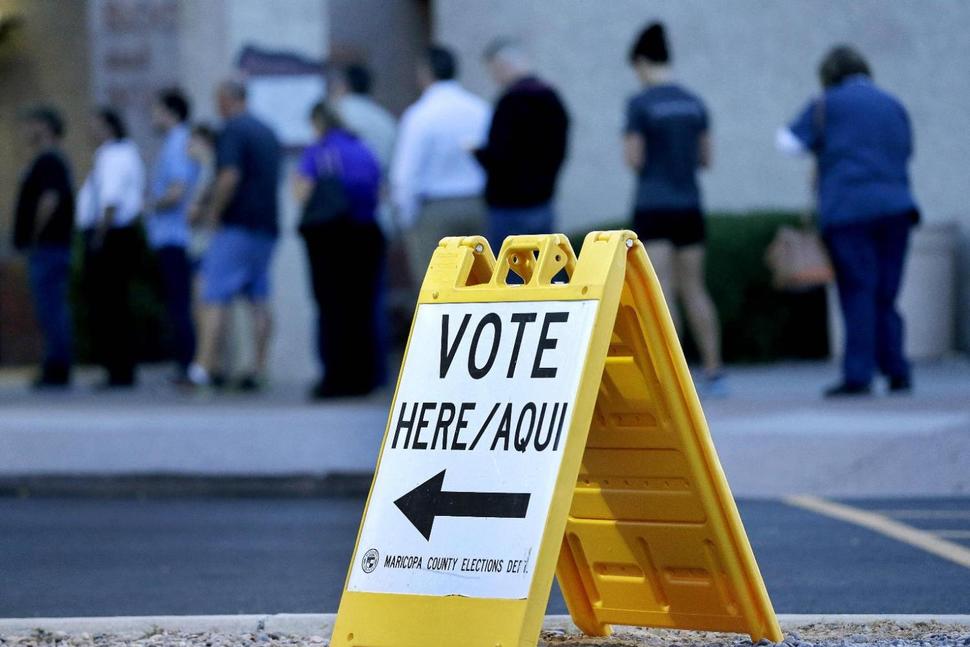
AP: long lines (again) in Phoenix for early voting

It seems that Maricopa County Recorder Helen Purcell has not fully complied with the recent settlement agreement entered into with the Democratic Party over long voting lines in Maricopa County. Democrats settle lawsuit over long lines at polling locations in Maricopa County.

The AP is reporting, More long lines in Phoenix as people vote early:

Phoenix-area voters hoping to avoid long lines on Election Day by casting early ballots ended up waiting anyway Wednesday.

Dozens of voters who crammed inside an office building in Glendale that was serving as a polling site reported waiting for more than two hours.

“We were in there like sardines,” said Vannessa Bonilla, 26, of Phoenix, a Republican who voted for the first time.

VotingLineVoters endured waits of more than five hours in the March primary. The county cut polling locations to just 60 from about 200 in the 2012 primary.

The wait prompted a civil rights group to file a lawsuit against Maricopa County. The county settled it by agreeing to implement a plan to avoid polling place wait time.

Deborah Eastman, 64, of Glendale, a registered Republican who voted Wednesday for Democrat Hillary Clinton, had hoped to make it to Clinton’s Phoenix rally. But after waiting 2 ½ hours, the substitute teacher didn’t think she would.

“I figured she’d rather have me vote for her than show up at the rally,” Eastman said.

The long wait time was largely due to limited staff and equipment to handle the unexpectedly large crowd. Voters have to fill out a slip before getting their ballot printed out. There was only one computer, one printer and a couple of workers assigned to the site.

Read more