From Kennedy to Hobby Lobby: the politicization of religion in America

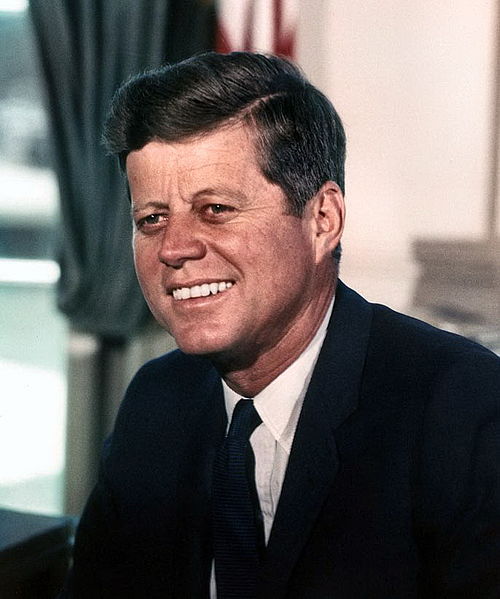
JFKWhen John F. Kennedy ran for president in 1960, he had to overcome religious bigotry and prejudice towards Catholics. There are those who then, and even still today, view Catholicism as a “false religion” and Catholics as “papists” who do the bidding of the Pope in Rome. Remember televangelist John Hagee’s remarks in 2008? Hagee to apologize to Catholics – – POLITICO.com.

To confront this concern about his religion, John Kennedy addressed the Greater Houston Ministerial Association on September 12, 1960. John F Kennedy speech – I Believe in an America Where the the Separation of Church and State is Absolute’:

[B]ecause I am a Catholic, and no Catholic has ever been elected President, the real issues in this campaign have been obscured–perhaps deliberately, in some quarters less responsible than this. So it is apparently necessary for me to state once again–not what kind of church I believe in, for that should be important only to me–but what kind of America I believe in.

I believe in an America where the separation of church and state is absolute–where no Catholic prelate would tell the President (should he be Catholic) how to act, and no Protestant minister would tell his parishioners for whom to vote–where no church or church school is granted any public funds or political preference–and where no man is denied public office merely because his religion differs from the President who might appoint him or the people who might elect him.
Read more

Shockingly, anti-choicers revealed to be liars. Yet again.

I’m not such a purist about honesty that I refuse to tell even a little white lie to spare someone’s feeling or to extract myself out of an awkward social or professional situation. But I think I’m like most people in that when someone brazenly and compulsively lies to me about matters big and small I find it offensive, as well as insulting to my intelligence. It disinclines me to want to continue any kind of relationship with that person, even if they are a close friend or family member. Brazen compulsive liars are toxic and a drain. Life is too short for that shit.

But, for some reason, where the debate over women’s reproductive rights is concerned (and why the fuck is there one still?), those of us on the side of the radical notion that women are people who should have bodily autonomy are expected to engage politely with people who believe the opposite. Even when said people lie repeatedly. When they claim that abortion causes breast cancer and depression (lie). When they claim the morning after pill causes abortion (lie). When they claim they are passing onerous laws that (just so happen to) close all the clinics in a region out of a concern for women’s safety (lie). When they swear up and down they are not after birth control (big fat lie). Etc.

On that last one, we now have undeniable proof of how much anti-choicers are willing to lie and just how far up that goes.

Read more

Must see: Couples talk about what marriage means to them

Connolly v Roche is one of the lawsuits before the US District Court in Phoenix seeking to overturn Arizona’s ban on gay marriage. The plaintiffs are asking for a summary judgement and sent these videos of the plaintiff’s to the judge to convey how the ban makes life difficult and scary for committed couples who … Read more

The “abortifacient” thing is really an attempt to fool themselves more than anyone else

Crossposted at DemocraticDiva.com

hobby lobby

Libby Anne of Patheos has an excellent run-down of Monday’s Hobby Lobby decision by the Supreme Court. Read the whole thing but I wanted to focus on this part here, which was very well put:

Next question, the majority says that the birth control mandate does place a “substantial burden” on Hobby Lobby’s religious beliefs. And this sentence is crucial: “The owners of the businesses have religious objections to abortion, and according to their religious beliefs the four contraceptive methods at issue are abortifacients.”

Note how carefully Alito worded that sentence, “according to their religious beliefs” these items are abortifacients. He had to word it this carefully because the four contraceptives at issue (Mirena, Paragard, Plan B, and Ella) are NOT, in fact, abortifacients according to the FDA. This is really crucial. The majority allowed Hobby Lobby to define for itself what in fact causes an abortion. There is a difference, you see, between saying “my religious belief is that abortion is immoral” [the religious belief Hobby Lobby has really pushed hard in all its filings] and saying “my religious belief is that Mirena causes abortion.” The first cannot and should not be challenged by a court, if that’s your belief, that’s your belief. The second is a question of fact, which can be proved or disproved via science. Individuals should not be able to declare that anything they dislike causes abortion and therefore avoid any laws relating to that item. Because there is no steady, safe line to draw between those who think IUDs cause abortions and those who think Tylenol causes abortion. Both are scientifically incorrect statements. For a court to accept the first and throw out the second because it’s “ludicrous” is picking and choosing favorites among religious beliefs, an extremely dangerous path.

Read more

Hobby Lobby and the return of SB 1062

Justice Samuel Alito suggests in his majority opinion in Burwell v. Hobby Lobby Here (.pdf) that the holding is limited to the issue of the birth control mandate under the Affordable Care Act. Alito assured us that he is not opening the door to future legal challenges to other laws that some find objectionable on religious grounds (wink, wink), as Justice Ruth Bader Ginsburg pointed out in her stinging dissent (the fact that Alito felt compelled to address the dissent numerous times in his majority opinion is a clear indication that Ginsburg cut close to the bone):

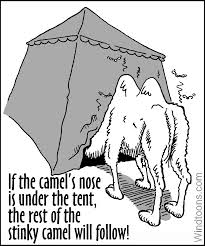
Camel“As this description of our reasoning shows, our holding is very specific. We do not hold, as the principal dissent alleges, that for-profit corporations and other commercial enterprises can “opt out of any law (saving only tax laws) they judge incompatible with their sincerely held religious beliefs.” Post , at 1 (opinion of GINSBURG, J.). Nor do we hold, as the dissent implies, that such corporations have free rein to take steps that impose “disadvantages . . . on others” or that require “the general public [to] pick up the tab.” Post , at 1–2. And we certainly do not hold or suggest that “RFRA demands accommodation of a for-profit corporation’s religious beliefs no matter the impact that accommodation may have on . . . thousands of women employed by Hobby Lobby.” Post, at 2.”

Justice Kennedy also sought to pooh-pooh the idea that the holding in this case was opening the door to future legal challenges to other laws that some find objectionable on religious grounds: “It seems to me appropriate, in joining the Court’s opinion, to add these few remarks. At the outset it should be said that the Court’s opinion does not have the breadth and sweep ascribed to it by the respectful and powerful dissent.”

Read more