President Obama announces ‘Clean Power Plan’

President Obama  released the final version of the EPA’s “Clean Power Plan” today. GET THE FACTS; Fact Sheet: President Obama to Announce Historic Carbon Pollution Standards for Power Plants.

The New York Times reports, Obama Unveils Plan to Sharply Limit Emissions:

carbon-emissionsPresident Obama on Monday unveiled an aggressive plan to sharply limit greenhouse gases emitted by the nation’s power plants, declaring that time was running out to thwart the most dangerous impacts of global climate change.

“No challenge poses a greater threat to our future and future generations than a changing climate,” Mr. Obama said in a speech from the East Room of the White House as he announced his most ambitious action to date to tackle the planet’s rising temperatures. “There is such a thing as being too late when it comes to climate change.”

Read more

GOP threatens government shutdown over Confederate flags and Planned Parenthood, but will not consider a bill to restore the Voting Rights Act

This coming Thursday, August 6, is the 50th anniversary of the Voting Rights Act of 1965, one of the most consequential pieces of legislation in American history.

Voting-RightsWhen the U.S. Supreme Court gutted the coverage section, Section 4 of the Act, in 2013 in Shelby County v. Holder, Chief Justice Roberts wrote that Congress remained free to try to impose federal oversight on states where voting rights were at risk, but must do so based on contemporary data.

The Tea-Publican controlled Congress has failed to act on this suggestion from the Court, preferring the status quo of a gutted Voting Rights Act, followed by the largest number of voting restrictions enacted by GOP states since the Jim Crow era.

A bipartisan bill introduced by Reps. Jim Sensenbrenner (R-Wis.) and John Conyers (D-Mich.) in response to the Supreme Court ruling that struck down Section 4 of the law in 2013 was introduced in 2014, and again earlier this year (The Sensenbrenner-Conyers bill, known as the Voting Rights Amendment Act). Bill To Restore Voting Rights Act Gets Another Bipartisan Push. A separate Democratic bill has also been introduced. Democrats Unveil Bill To Restore Gutted Voting Rights Act (The Voting Rights Advancement Act of 2015, which goes beyond the version introduced in 2014).

Democrats have made a push for Congress to vote on these bills on the eve of the anniversary of the Voting Rights Act, but Tea-Publican congressional leaders have refused.

Read more

The GOP campaign to dismantle the Voting Rights Act of 1965

This coming Thursday, August 6, is the 50th anniversary of the Voting Rights Act of 1965, one of the most consequential pieces of legislation in American history.

Jim Rutenberg of The New York Times in a lengthy exposé, “A Dream Undone,” examines the 50 year GOP campaign to dismantle this landmark piece of legislation. A Dream Undone (excerpts):

Screenshot from 2015-08-01 16:19:52[I]n the American South in 1956, not every would-be black voter was an Air Force officer with the wherewithal to call on the local election board; for decades, most had found it effectively impossible to attain the most elemental rights of citizenship. Only about one-quarter of eligible black voters in the South were registered that year, according to the limited records available. By 1959, when Frye went on to become one of the first black graduates of the University of North Carolina law school, that number had changed little. When Frye became a legal adviser to the students running the antisegregation sit-ins at the Greensboro Woolworth’s in 1960, the number remained roughly the same. And when Frye became a deputy United States attorney in the Kennedy administration, it had grown only slightly. By law, the franchise extended to black voters; in practice, it often did not.

What changed this state of affairs was the passage, 50 years ago this month, of the Voting Rights Act. Signed on Aug. 6, 1965, it was meant to correct “a clear and simple wrong,” as Lyndon Johnson said. “Millions of Americans are denied the right to vote because of their color. This law will ensure them the right to vote.” It eliminated literacy tests and other Jim Crow tactics, and — in a key provision called Section 5 — required North Carolina and six other states with histories of black disenfranchisement to submit any future change in statewide voting law, no matter how small, for approval by federal authorities in Washington. No longer would the states be able to invent clever new ways to suppress the vote. Johnson called the legislation “one of the most monumental laws in the entire history of American freedom,” and not without justification. By 1968, just three years after the Voting Rights Act became law, black registration had increased substantially across the South, to 62 percent. Frye himself became a beneficiary of the act that same year when, after a close election, he became the first black state representative to serve in the North Carolina General Assembly since Reconstruction.

Read more

Medicaid (AHCCCS) expansion challenge argued to Court

I explained some time ago that this is no longer about Gov. Jan Brewer’s Medicaid (AHCCCS) expansion plan for the Goldwater Institute lawyers representing the Tea-Publican legislators/plaintiffs in this case. It is about preserving the GOP’s anti-democratic “weapon of mass destruction,” Prop. 108 (1992). ‘Kochtopus’ Death Star still trying to kill Medicaid (AHCCCS):

DeathStarThis case is no longer about Medicaid expansion for the “Kochtopus” Death Star. No, it is now only concerned about preserving its undemocratic Prop. 108 (1992), which requires a two-thirds supermajority vote in both legislative chambers to impose or increase any taxes, or to reduce any tax credits or exemptions.  This antidemocratic provision only enables a tyranny of a minority of anti-tax zealots (the “Kochtopus” and its minions), negating simple majority rule, the foundation of a democracy.

Here is what self-described “libertarian constitutional lawyer and freedom fighter” Christine Sandefur said in an op-ed in The Republic last month. The real ‘sore losers’ in Medicaid-tax case:

In a Feb. 11 editorial, The Arizona Republic’s editorial board dubbed these lawmakers “sore losers” for appealing that ruling.

* * *

Sadly, if this ruling stands, the real losers will not be the legislators but the voters and the state Constitution.

Preoccupied with lambasting the legislators for obstructing Medicaid expansion, the editorial board misses the forest for the trees. The desirability of the Medicaid program isn’t on trial; that’s a policy question left to the political process. The stakes of this lawsuit are much higher. At issue is the fate of a critical voter-approved constitutional protection, Proposition 108, which requires a two-thirds legislative supermajority for all new taxes and fees. The Medicaid tax became law with the approval of only a simple majority, nullifying the votes of those legislators who opposed it.

Read more

Closing arguments in North Carolina Voting Rights Act trial

The parties rested their case on Thursday in the Voting Rights Act trial in North Carolina. Closing arguments were made to the Court on Friday morning, and this afternoon. Here are two articles from the Winston-Salem Journal about the close of the trial.

Here is the preview of today’s closing arguments. Closing arguments in voting rights trial set for today:

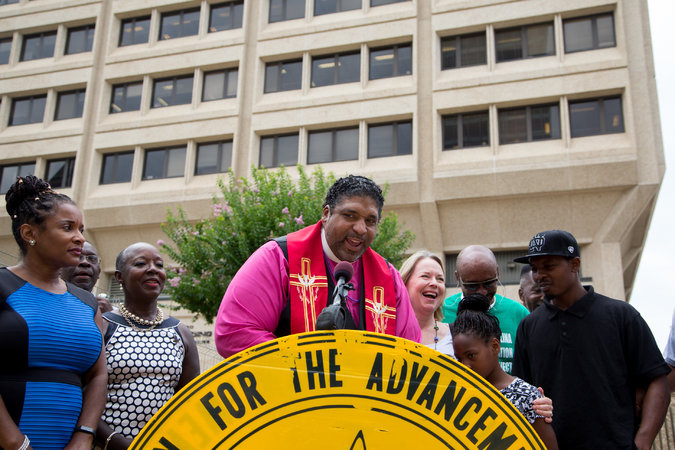
WillimaBarberBy about noon, a three-week trial on North Carolina’s election law — one of the most sweeping changes in voting practices in the country since the U.S. Supreme Court dealt what critics consider a blow to the Voting Rights Act of 1965 — will end, and the decision on whether the law discriminates against racial minorities will be left up to a federal judge.

Attorneys on both sides officially rested their cases Thursday. State attorneys rested after calling their sixth witness — Brian Neesby, business systems analyst for the State Board of Elections. Plaintiffs, including the N.C. NAACP, called four rebuttal witnesses, including Allan Lichtman, a political science professor at American University, and Charles Stewart III, a political science professor at Massachusetts Institute of Technology. Plaintiffs also called Daphne Ganey, 25, who is from Winston-Salem, and George Bailey, 21, a student at Winston-Salem State University.

U.S. District Judge Thomas Schroeder is presiding over the case and will ultimately make the decision later this year.

Read more