50th Anniversary of Medicare/Medicaid, Republicans are still trying to kill it

There is something surreal about Biggs, et al v. Brewer, et al. (CV2013-011699 Maricopa County Superior Court), the Medicaid (AHCCCS) expansion case brought by almost every Tea-Publican legislator in the Arizona legislature, being heard today in court on the 50th Anniversary of the The Social Security Amendments of 1965 creating the Medicare and Medicaid programs. Medicaid (AHCCCS) expansion case set for hearing on July 30, 2015.

These Tea-Publican legislators are seeking to take away Medicaid (AHCCCS) health insurance coverage for an estimated 300,000 recipients (est. 463,000 Arizonans are eligible). Arizona Medicaid: eligibility, enrollment and benefits. I hope that one of the attorneys will point out the significance of today’s date to the Court.

On July 30, 1965, President Johnson signed the Social Security Amendments which established Medicare and Medicaid, promising that they would “improve a wide range of health and medical services for Americans of all ages.”

Former President Harry S. Truman was at his side in Independence, Missouri. Johnson credited Truman with “planting the seeds of compassion and duty which have today flowered into care for the sick and serenity for the fearful.”

LBJ_Medicare_Bill_Signing34896web
Medicare bill signing,Date: 7/30/65, Harry S. Truman Library, Independence, Missouri.
Read more

California’s minor political parties appeal ‘top-two’ electoral system to U.S. Supreme Court

In January of this year, the Court of Appeal of the State of California (1st District, Division 1) upheld California’s “top-two” primary electoral system in the case of Rubin v. Padilla (.pdf):

StopTop2We affirm the trial court’s dismissal of the action. Given the structure of California’s “top-two” electoral system, minor-party candidates have no right to appear on the general election ballot merely because they have made a showing of significant public support. The role played by the general election under the former partisan system is fulfilled by the primary election in the top-two system, and there is no material barrier to minor-party participation in the primary election. Further, the failure of minor-party candidates to appear on the general election ballot does not substantially burden their members’ rights of political association and expression, and California’s interest in expanding participation in the electoral process is adequate to justify any burden that may occur. Lastly, because California’s electoral system treats all political parties identically, plaintiffs’ claim that they are denied equal protection of the laws is groundless.

This is a sweeping dismissal of minor political party rights and limiting the choices of voters in a general election.

Read more

(Update) Plaintiffs rest case in Voting Rights Act trial in North Carolina

I have been a bit remiss in reporting on this case. If you want daily trial updates, you should visit Rick Hasen’s Election Law Blog via the Winston-Salem Journal.

After two weeks of testimony, the Plaintiffs rested their case this week. The state of North Carolina will present its defense beginning Monday. The Winston-Salem Journal reports, Plaintiffs rest case in federal trial over NC voting law:

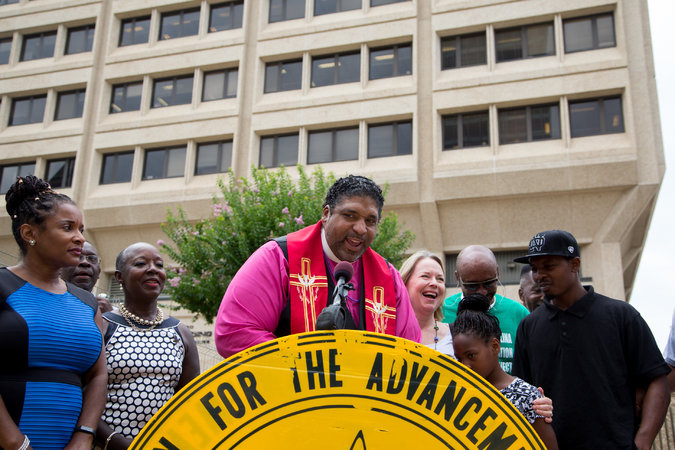
WillimaBarberAfter two weeks, attorneys representing the N.C. NAACP and other groups rested their case Friday, having called more than 40 witnesses who testified either in court or via video depositions, that North Carolina’s election law is racially discriminatory.

Now, it is the state’s turn to present evidence. Attorneys representing North Carolina and Gov. Pat McCrory called Janet Thornton, an economist, as their first witness. Thomas Farr, one of the attorneys for the state, said they expect to finish presenting evidence by Wednesday.

Read more

Judge Snow calls out the U.S. Marshal for Crazy Uncle Joe Arpio’s failure to comply with his orders

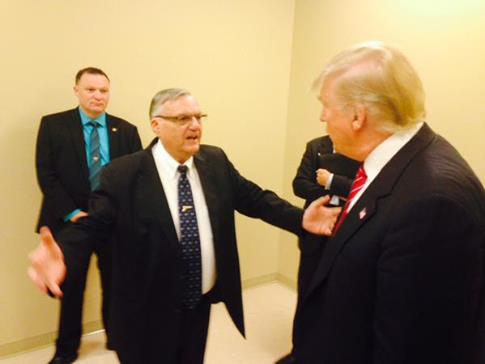
Trump-ArpaioAfter evading justice, once again, when the U.S. Department of Justice decided to settle its case with Maricopa County rather than prosecute the “Most Corrupt Sheriff in America” to a conviction, Crazy Uncle Joe Arpaio evades ‘Justice’ again, Crazy Uncle Joe Arpaio did not fare as well with U.S. District Court Judge Murray Snow last week, and ended the week with yet another example of his department’s obstruction of justice and contempt of court.

Stephen Lemons of the Phoenix New Times reported on the status conference last Monday, Snow Allows DOJ to Review Montgomery Docs, Denies Stay Request, Sets Dates for Further Contempt Hearings:

During an hour-long status conference Monday in Sheriff Joe Arpaio’s never-ending contempt case, federal Judge G. Murray Snow granted a request by the U.S. Department of Justice to review documents from Arpaio’s confidential informant Dennis Montgomery in the MCSO’s so-called “Seattle investigation.”

That investigation, as first revealed in June of last year by Phoenix New Times, was an attempt by Arpaio and his Chief Deputy Jerry Sheridan to gin up a conspiracy theory involving Snow, the DOJ, former U.S. Attorney General Eric Holder and others, in an effort to conflict Snow off the ACLU’s big civil rights case Melendres v. Arpaio.

Read more

Battle Royale over ‘dark money’ brewing in Arizona

dark_moneyArizona Secretary of State Michele Reagan duped voters last year into believing that she cared about “dark money” campaign disclosures (I warned you that she was lying).

Since having been elected to office, Reagan has not only done nothing to address “dark money” campaign disclosures but she has now come to the conclusion that — surprise! — “my office does not have authority” to regulate dark money campaign disclosures. Reagan: ‘Dark money’ disclosure can’t happen.

If the Secretary of State, the principal election officer in Arizona, doesn’t have authority to regulate “dark money” campaign disclosures, then who does?

In Arizona we have the Citizens Clean Elections Commission, enacted by a citizens initiative, something we know that Republican office holders hate after having tried to kill the Citizens Clean Elections Commission for years.

The Commission says it has the authority to regulate “dark money” disclosures and is proposing a rule to do something about it.

Secretary of State Michele Reagan, who refuses to do anything about “dark money” campaign disclosures says “Uh-uh, no way! I am the Queen of elections in Arizona! I am the law!” So it looks as if we are headed for a battle royale over “dark money” campaign disclosures in Arizona.

Still lurking out there is Terry Goddard’s “dark money” campaign disclosure initiative by VPA Arizona yet to be filed.

Read more