NY Times: Justice John Roberts opinion not supported by the facts in gutting the Voting Rights Act

Chief Justice John Roberts, who established his reputation during the Reagan administration with his attacks on the Voting Rights Act, Chief Justice Roberts’ Long War Against the Voting Rights Act, rejected the empirical evidence to assert that discrimination no longer occurs in “covered jurisdictions” in striking down the coverage formula enacted by a near unanimous Congress in Section 4 of the Voting Rights Act of 1965, which had the effect of leaving the U.S. Justice Department preclearance provisions in Section 5 in suspension.

Justice Roberts opinion in Shelby County v. Holder opened the floodgates to new GOP voter suppression efforts in those covered jurisdictions within hours of the decision. After Ruling, States Rush to Enact Voting Laws.

New research demonstrates how Justice Roberts’ opinion was full-o’-crap. The New York Times editorializes, Voting Rights, by the Numbers:
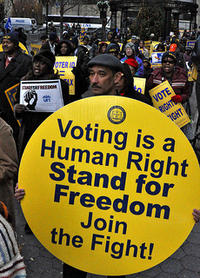
Voting-RightsWhen the Supreme Court struck down the heart of the Voting Rights Act in 2013, its main argument was that the law was outdated.

Discrimination against minority voters may have been pervasive in the 1960s when the law was passed, Chief Justice John Roberts Jr. wrote, but “nearly 50 years later, things have changed dramatically.” In this simplistic account, the law was still punishing states and local governments for sins they supposedly stopped committing years ago.

The chief justice’s destructive cure for this was to throw out the formula Congress devised in 1965 that required all or parts of 16 states with long histories of overt racial discrimination in voting, most in the South, to get approval from the federal government for any proposed change to their voting laws. This process, known as preclearance, stopped hundreds of discriminatory new laws from taking effect, and deterred lawmakers from introducing countless more.

But Chief Justice Roberts, writing for a 5-4 majority, invalidated the formula because “today’s statistics tell an entirely different story.”

Well, do they? A comprehensive new study by a historian of the Voting Rights Act provides a fresh trove of empirical evidence to refute that assertion. The study by J. Morgan Kousser, a professor of history and social science at the California Institute of Technology, examines more than 4,100 voting-rights cases, Justice Department inquiries, settlements and changes to laws in response to the threat of lawsuits around the country where the final result favored minority voters.

It found that from 1957 until 2013, more than 90 percent of these legal “events” occurred in jurisdictions that were required to preclear their voting changes. The study also provides evidence that the number of successful voting-rights suits has gone down in recent years, not because there is less discrimination, but because several Supreme Court decisions have made them harder to win.

Read more

If Montana can do it, why can’t Arizona?

In news that you did not see reported here in Arizona last week, the Montana legislature passed sweeping campaign finance legislation that will require the disclosure of all donors to any independent group spending money on state-level elections.

The Huffington Post reported, Montana Republicans And Democrats Unite To Ban Dark Money:

dark_moneyThe bipartisan Montana Disclose Act will effectively end the flood of “dark money” — electoral spending by nonprofit groups that do not disclose their donors — that has plagued recent Montana elections.

“Montana elections are about to become the most transparent in the nation, requiring those trying to influence our elections to come out of the dark money shadows,” Gov. Steve Bullock (D), who plans to sign the bill, said in a statement. “Our elections should be decided by Montanans, not shadowy dark money groups.”

The bill will require all groups, no matter their tax status, to disclose their donors if they spend money on electoral communications either targeting or mentioning a candidate within 60 days of an election.

“What Montana shows is that the issue of money in politics is really only a partisan issue in Washington, D.C.,” Adam Smith, spokesman for the campaign finance reform group Every Voice, said. “People can come together — Republicans and Democrats — and pass real effective reforms of the system.”

Read more

Carbon Monopoly tries to preemptively stop the EPA’s proposed Clean Power Plan rule

The Carbon Monopoly and its Tea-Publican lickspitter servants were in the U.S. Court of Appeals for the District of Columbia on Thursday trying to preemptively stop the Environmental Protection Agency (EPA)’s proposed Clean Power Plan rule before a final rule has even been published.

The judges did not appear to be buying it. Think Progress reports, Federal Judge On Stopping EPA Rule: ‘Why Would We Do That?’:

carbon-emissionsA coal mining company, West Virginia, and 15 other states argued Thursday that a federal court should stop the Environmental Protection Agency (EPA)’s proposed Clean Power Plan rule, but the three presiding judges did not seem convinced.

If the U.S. Court of Appeals for the District of Columbia finds in favor of the petitioners, it would be a first for the rule-making process. The court has never issued a writ against a rule that has not been finalized.

“Do you know of any case when we have stopped rule-making? Why would we do that?” Judge Thomas Griffith asked Elbert Lin, an attorney for West Virginia, at the outset of the proceedings.

Read more

Hillary Clinton supports the Move to Amend movement

Earlier this week, former Secretary of State Hillary Clinton, at the first official event of her presidential campaign, spelled out the ideas that she said will be at the heart of her campaign. In Iowa, Hillary Clinton lays out big vision for her campaign:

“I want to be the champion who goes to bat for Americans in four big areas,” she told four students and two educators at a roundtable staged in an automotive technology classroom at a branch campus of Kirkwood Community College.

It was the first time Clinton had laid out specific campaign themes since she announced on Sunday in a short video that she’s in the 2016 race for the Oval Office.

“ We need to build the economy of tomorrow, not yesterday,” she said, as a handpicked audience of about 20 and about 60 reporters seated nearby behind a yellow ropeline looked on.

“We need to strengthen families and communities because that’s where it all starts.

And we need to fix the dysfunctional political system and get unaccountable money out of it once and for all, even if that takes a constitutional amendment.

And we need to protect our country from threats that we see and the ones that are on the horizon. So I’m here in Iowa to begin a conversation about how we do that.”

TheGraduateWait, what now?

A major theme of the Hillary Clinton campaign is the Move to Amend movement for a constitutional amendment to overturn Citizens United v. FEC and its progeny?  “Mrs. Robinson, you’re trying to seduce me. Aren’t you?”

Apparently so. Hillary Clinton says she would support a constitutional amendment on campaign finance reform:

Hillary Rodham Clinton is calling for changes to the nation’s campaign finance system, saying here Tuesday that she would support a constitutional amendment if that’s what it takes to fix what she called a “dysfunctional” system.

Read more

It’s game on! Crazy Uncle Joe Arpaio contempt of court hearing next week

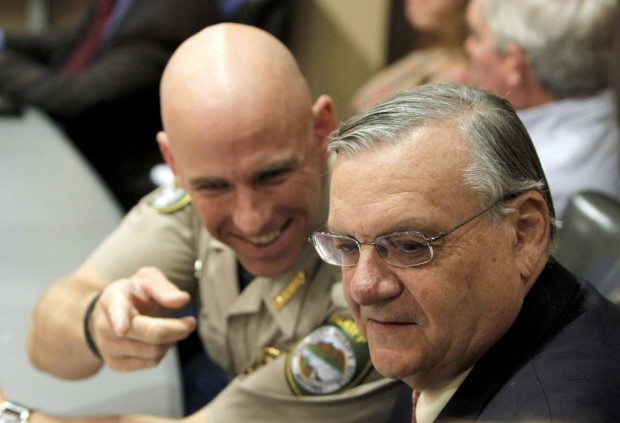
Babeu-ArpaioIt’s game on! Crazy Uncle Joe Arpaio is having a bad week, and its going to get worse next week he goes on trial for contempt of court. We may finally be seeing the beginning of the end of the “most corrupt sheriff in America.”

This week the Ninth Circuit Court of Appeals upheld U.S. District Judge G. Murray Snow’s 2013 ruling against the Maricopa County Sheriff’s Office for illegal racial-profiling. Racial-profiling ruling vs. Arpaio largely upheld:

A three-judge panel of the 9th U.S. Circuit Court of Appeals largely upheld a federal judge’s ruling against the Maricopa County Sheriff’s Office in a racial-profiling case, according to a statement filed Wednesday.

In 2013, U.S. District Judge G. Murray Snow found Sheriff Joe Arpaio’s deputies had disproportionately targeted Latinos during their traffic operations. The ruling extended to both regular and “saturation” patrols, where deputies would flood predominantly Hispanic neighborhoods.

Arpaio’s subsequent appeal did not contest the saturation patrol finding, only the portion dealing with regular patrols.

The appeals court upheld the federal judge’s inclusion of non-saturation patrols in his finding of racial profiling, and additionally maintained his rulings of corrective actions that included training and video-recording of traffic stops.

“I think it marks a significant victory,” said Cecillia Wang, a plaintiffs’ attorney with the American Civil Liberties Union’s Immigrants’ Rights Project. “Once again the sheriff’s efforts to continue his policy on immigration enforcement have been rebuffed by a federal court.”

The panel did agree with the appeal in one respect, and ruled that the court-appointed monitor’s oversight of internal investigations must only be related to the constitutional violations.

Read more