SCOTUS declines Wisconsin voter ID case

U.S. Supreme Court observers believed that the Court would grant review in the voter ID case from Wisconsin, Frank v. Walker (14-803), because it presented the case for which the Court left the door open in its decision in Crawford v. Marion County Election Board:

VotersIssue: (1) Whether a state’s voter ID law violates the Equal Protection Clause where, unlike in Crawford v. Marion County Election Board, the evidentiary record establishes that the law substantially burdens the voting rights of hundreds of thousands of the state’s voters, and that the law does not advance a legitimate state interest; and (2) whether a state’s voter ID law violates Section 2 of the Voting Rights Act where the law disproportionately burdens and abridges the voting rights of African-American and Latino voters compared to White voters.

This morning the Court disappointed many election law attorneys by denying review in this case. Supreme Court turns away challenge to Wisconsin’s voter ID law:

The Supreme Court on Monday turned down a challenge to Wisconsin’s voter ID law, which it had previously kept from going into effect before November’s elections.

Read more

The return of ‘religious liberty’ bills — state sanctioned discrimination

RoccosIt is now too late in the legislative session for the revival of SB 1062, the so-called Religious Liberty bill to legalize discrimination against gays — and any other minority one’s “personal religious beliefs” says they can discriminate against — from being introduced in the Arizona legislature. This would amount to state sanctioned discrimination.

Depending on how the U.S. Supreme Court rules on the same-sex marriage appeals at the end of June, I would expect Cathi Herrod and her Christian Taliban to be back with SB 1062 in the next legislative session.

In fact, Tea-Publican lawmakers in places like Georgia, Arkansas, and Oklahoma are already taking up bills “that would make it easier for businesses and individuals to opt out of serving gay couples on religious grounds.” States Weigh Legislation to Let Businesses Refuse to Serve Gay Couples:

As it looks increasingly likely that the Supreme Court will establish a nationwide right to same-sex marriage later this year, state legislatures across the country are taking up bills that would make it easier for businesses and individuals to opt out of serving gay couples on religious grounds.

Many states are now reliving a version of events that embroiled Arizona in February 2014, when Gov. Jan Brewer, a Republican, vetoed a bill that would have allowed businesses to use their religious beliefs as a legal justification for refusing to serve gay customers.

Read more

Judge to Crazy Uncle Joe Arpaio: No deal

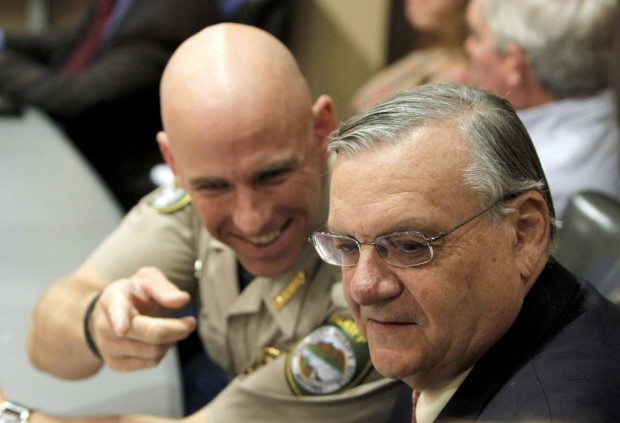
Babeu-ArpaioKudos to the Arizona Civil Liberties Union for objecting to the half-ass settlement offer from Crazy Uncle Joe Arpaio and his lawyers that would have let him avoid prosecution, and saddle the taxpayers of Maricopa County — the damn fools who keep reelecting him — with the cost of the settlement agreement, once again. Crazy Uncle Joe Arpaio has already cost county taxpayers multi-millions of dollars in settlements for his unlawful conduct. When will Maricopans finally say “enough!”

And kudos to U.S. District Judge G. Murray Snow for not rolling over like other judges have done in the past by accepting this half-ass settlement offer. Judge Snow told Crazy Uncle Joe Arpaio and his lawyers, “No deal” — see you boys in court at the hearing set for April 21-24. Justice may finally be coming for “America’s most corrupt sheriff.”

Read more

Jim Nintzel nails it on Ducey’s budget

Hats off to Jim Nintzel of the Tucson Weekly for his cover story this week, So I Elected an Ax Murderer (a word play on Mike Myers’ So I Married an Axe Murderer (1993). Read the whole article, but here is the meat of Nintzel’s analysis.

Cover
Six Things To Know About the New State Budget

Here are six things to know about the state budget:

1. Education Got Clobbered

K-12 education saw increases in some areas but reductions in others for a total increase of $81 million in the upcoming budget year. The state was required by formula to increase spending by $250 million, but lawmakers reduced a number of other funding programs by $169 million, according to a Joint Legislative Budget Committee summary.

The biggest cut was a general reduction of $117 million of what Ducey originally pitched as “non-classroom spending” by district, but by the final budget allows districts to decide where to cut those dollars.

Lawmakers also cut funding for district-sponsored charter schools, which will lose half of their funding this year and all of it in fiscal year 2017.

Also in fiscal year 2017, the state is cutting $30 million in support of Joint Technical Education Districts, which are designed to help students develop vocational skills. That’s of particular importance to students who don’t intend to go to college, but also helps some students get a head start on their college education.

Left unresolved is the outcome of an ongoing lawsuit over whether lawmakers have properly funded education based on population growth and inflation. So far, the Arizona Supreme Court has ruled that the lawmakers did not properly do so and the case has been sent back down to Maricopa Superior Court, where legal arguments are ongoing.

Read more

Crazy Uncle Joe Arpaio admits civil contempt, trying to avoid prosecution

Stephen Lemons of the Phoenix New Times has the latest on Crazy Uncle Joe Arpaio and his pending contempt hearing before U.S. District Court Judge G. Murray Snow. Joe Arpaio Admits Guilt in Civil Contempt Case, Seeks to Avoid April Hearing:

Babeu-ArpaioIn a bombshell filing in federal court Tuesday, Sheriff Joe Arpaio and his Chief Deputy Jerry Sheridan admitted that they are guilty of civil contempt, in a blatant attempt to avoid an upcoming civil trial before U.S. District Court Judge G. Murray Snow.

Since earlier this year, when Snow ordered a four day civil contempt hearing to address allegations that Arpaio and four former and current aides have disobeyed the judge’s orders in the ACLU’s big racial profiling case, Melendres v. Arpaio, the sheriff and his co-defendants have sought to wiggle out of the de facto trial, scheduled for April.

Arpaio, et al. have sought assurances that the civil charges would not be forwarded to the U.S. Attorney’s Office for possible criminal action, and have tried to settle the matter with the plaintiffs in the case, all to no avail.

Now, Arpaio and Sheridan are admitting wrongdoing, promising to make good, and pleading for mercy from Judge Snow.

Read more