House Tea-Publicans pass a symbolic anti-abortion bill to save face

After the Tea-Publican House leadership failed to muster a majority among its own members for Rep. Trent Franks’ unconstitutional 20-week ban on abortions, being forced to pull the bill Wednesday night,  they finally settled upon a replacement with a symbolic, but potentially far more damaging bill, HR 7.  Bill PDF.

Joan McCarter at Daily Kos reports, House Republicans include a tax hike in their latest abortion bill:

Taliban[Tea-Publicans] revived their long-standing effort to codify a ban on federal funding of abortion that even extends to private insurance, and plans sold in Obamacare insurance exchanges. But it’s also a tax-hike on small businesses who provide employees with health insurance that covers abortion.

Under the SHOP exchange, a part of the Affordable Care Act, small businesses receive a tax credit if they include abortion care in their plans. Roughly 87 percent of private plans include abortion services as part of comprehensive coverage, meaning the bulk of small businesses would be hit with a tax hike if the bill, called the No Taxpayer Funding for Abortion Act, were to become law.

As Minority Leader Nancy Pelosi pointed out, House Republicans have shifted their attack from the thousands of women with the 20-week abortion ban to millions of women who would have this legal medical procedure stripped from their private insurance, for which they are paying.

[The bill also includes limitations on federal facilities and employees (e.g., military/veteran hospitals),  and local government funding for the District of Columbia.]

Read more

Rep. Stefanie Mach files bills for LGBT non-discrimination

Pride-Flag-Thumbnail-Friday-3x2-256x171Earlier this year I posted that Democrats should pursue a ballot measure in 2016 to amend the Arizona Civil Rights Act (ACRA) to prohibit discrimination on the basis of gender identity or sexual orientation in employment, public accommodations, and housing in the same manner as other protected classes currently covered under the ACRA.

This is broader coverage than the proposed federal Employment Non-Discrimination Act (ENDA).

I recommended a ballot measure because a version of this bill has been submitted in the Arizona legislature every year since at least 1994, but it has never been approved by the Arizona legislature.

Rep. Stefanie Mach (D-Tucson) has submitted this year’s version of the bill, HB 2188 (.pdf) employment, currently cosponsored by 9 Democrats, and HB 2189 (.pdf) housing, currently cosponsored by 3 Democrats. Lawmakers Try Again To Protect LGBT Community From Workplace Discrimination:

“Marriage equality happened through the courts, but we haven’t really seen equality, full equality, for people in that community yet and I think that part of that is making sure that nobody can be fired on the basis of gender expression or gender identity,” said Representative Stefanie Mach, D-Tucson, the primary sponsor who introduced the bill on Thursday along with five other sponsoring representatives and three senators.

Read more

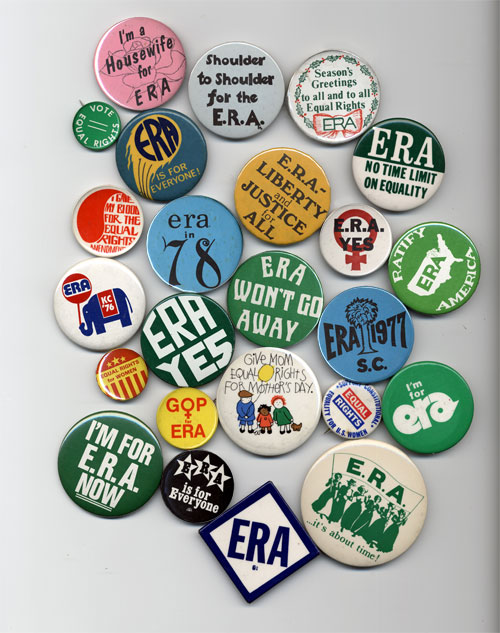
Rep. Victoria Steele reintroduces an ERA Resolution

ERA-1Last year Rep. Victoria Steele (D-Tucson) introduced HCR 2016 (.pdf), a resolution recommending the ratification of the federal Equal Rights Amendment to the U.S. Constitution. It had bipartisan support among its cosponsors, but went nowhere.

Rep. Steele has refiled her ERA resolution in this session, HCR 2020 (.pdf). Steele’s 26 cosponsors, so far, are all Democrats.

What, Republicans do not believe that women should enjoy equal rights under the law equal to men? The ERA has always had bipartisan support.

Last year’s Republican cosponsors were Karen Fann, Michelle Ugenti, and Kelly Townsend (Ethan Orr is no longer in the legislature). Step up, ladies! And bring some of those Republican men with you.

Read more

CBO reports contradict the claims in King v. Burwell

ObamacareIn early March the U.S. Supreme Court will hear oral arguments in King v. Burwell, in which Libertarian lawyers who write for the Volokh Conspiracy at the Washington Post will make a  Textualism argument that the text of “ObamaCare” limits federal subsidies only to people who buy insurance from state-run exchanges, not from the federal exchange.

The “textualism” argument would require the Court to abandon its “Chevron deference,” i.e., that when a federal statute is ambiguous, courts defer to the agency’s interpretation (in this case the IRS). Chevron U.S.A. v. Natural Resources Defense Council, Inc. (1984).

The “textualism” argument would also require the Court to abandon a long-established canon of statutory construction, what Justice Scalia just last year in Utility Air Regulatory Group v. EPA called “the fundamental canon of statutory construction that the words of a statute must be read in their context and with a view to their place in the overall statutory scheme.”

The “textualism” argument would also require the Court to abandon examination of the congressional record to determine congressional intent, a practice the Court has routinely engaged in. On this topic, Sarah Kliff at Vox.com reports on the research by Theda Skocpol who finds no support the argument being made by the Libertarian lawyers in this case. Analysis: CBO contradicted the latest case against Obamacare 68 different times:

The Congressional Budget Office wrote 68 reports about the Affordable Care Act during the session that Congress debated the law. Not one of them, a new analysis from Harvard University’s Theda Skocpol, ever explored the possibility of limiting insurance subsidies to the state marketplaces after the law’s full implementation.

Read more