
I have been catching up on the numerous election law case briefs moving through the federal courts recently. I finally had time to review the 7th Circuit Court 5-5 split denying en banc review of Wisconsin’s voter ID law, which the U.S. Supreme Court has since stayed for this election.
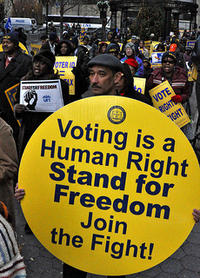 I don’t recall this receiving national news media attention at the time, but it should have: conservative icon Judge Richard Posner, the author of the appellate court opinion in Crawford v. Marion County Election Board upholding Indiana’s voter ID law, has made an 180 degree turnabout and wrote a blistering dissent against Wisconsin’s voter ID law. Judge Posner asked for the en banc review vote himself, and wrote a 28 page dissent to the refusal of the 7th Circuit to take up the case en banc.
The Wisconsin Journal-Sentinel reported, Appeals court dissenters blister state’s voter I.D. law:
Just 14 hours after the U.S. Supreme Court blocked Wisconsin’s voter ID law for the Nov. 4 election, five appeals court judges Friday issued a blistering opinion calling allegations of voter impersonation fraud “a mere fig leaf for efforts to disenfranchise voters likely to vote for the political party that does not control the state government.”
“Some of the ‘evidence’ of voter-impersonation fraud is downright goofy, if not paranoid, such as the nonexistent buses that according to the ‘True the Vote’ movement transport foreigners and reservation Indians to polling places,” wrote Judge Richard A. Posner of the 7th Circuit U.S. Court of Appeals.
Posner, who was appointed to the federal bench by President Ronald Reagan in 1981, was joined by four others in his dissenting opinion. The five other judges on the court did not spell out their views on the ID requirement.
The latest ruling had no immediate practical effect, and the voter ID law remains blocked for the election.
Posner is one of the most influential judges in the country, and his writing may persuade the U.S. Supreme Court if it ultimately decides to scrutinize Wisconsin’s voter ID law.His views on voter ID are seen as key because seven years ago he wrote an opinion upholding Indiana’s law requiring identification at the polls.
* * *
Last month, a three-judge panel of the 7th Circuit Court of Appeals ruled the voter ID law could go into place for the upcoming election while it considered the case. It followed that up with an order Monday that upheld the measure.
Opponents of voter ID asked to block those rulings, and the U.S. Supreme Court halted it Thursday. Its one-page ruling put the law on hold until the justices decide whether to review the voter ID law.
Separately, Posner wrote Friday he had asked for the full 10-member appeals court to review the panel’s latest decision. The court split 5-5 on doing that, but Posner and his colleagues wrote a lengthy dissent saying Wisconsin’s voter ID law should be invalidated.
“The movement in a number of states including Wisconsin to require voters to prove eligibility by presenting a photo of themselves when they try to vote has placed an undue burden on the right to vote, a right that the Supreme Court has found latent in the Constitution,” Posner wrote for the five.
Posner was joined in his dissent by Diane P. Wood and Ann Claire Williams, both appointed by President Bill Clinton; Ilana Diamond Rovner, appointed by President George H.W. Bush; and David F. Hamilton, appointed by President Barack Obama.
* * *
Posner said there are major differences between Wisconsin and Indiana’s laws, as well as between the evidence presented in the cases challenging the ID requirements. He noted Indiana accepts more types of IDs for voting than Wisconsin does, and that more people in Wisconsin lack the credentials that would be necessary to vote — 300,000 people, compared to 43,000 in Indiana at the time its law was being challenged.
The panel that ruled in the case, however, found it “questionable” that so many voters in Wisconsin lacked the type of IDs allowed for voting.
Friday’s writing is significant because in 2007 Posner wrote the opinion for an appeals panel that upheld Indiana’s law. The decision he authored was affirmed by the Supreme Court when it considered the case a year later.
He has been closely watched on the issue because last year he wrote in a book that Indiana’s voter ID law is “now widely regarded as a means of voter suppression rather than fraud prevention.”
Posner’s latest opinion referred disparagingly to True the Vote, a national group that backs voter ID requirements. In Wisconsin, True the Vote worked with tea party groups in 2012 to establish an online database of everyone who signed petitions to recall Walker and other Republicans.
The Milwaukee Journal-Sentinel followed up with an editorial opinion on Sunday. Judge Richard A. Posner’s riposte skewers state’s flawed voter ID law:
Five appeals court judges gave their colleagues the what-for Friday in a bark-peeling attack rarely seen in the legal genre. Led by Judge Richard A. Posner, himself a convert to the idea that voter ID equals voter suppression (good for him), the judges called the idea of voter fraud by impersonation “a mere fig leaf for efforts to disenfranchise voters likely to vote for the political party that does not control the state government.”
Which is precisely what is afoot in Wisconsin.
It has been clear from the day this rancid idea began working its way through the state Legislature that this was all about winning elections and not about the integrity of those elections. Voter ID makes it harder for certain classes of voters to exercise the franchise, including minorities, the elderly and the young. The fact that those categories of voters tend to favor Democrats should tell you all you need to know about the motivations of Republican legislators.
It’s about winning, baby, which is about integrity only in the sense that up is about down or that white is about black.
Posner has gotten religion on this issue. Appointed to the bench by President Ronald Reagan, he was the author of an opinion for an appeals panel in 2007 that upheld a similar voter ID law in Indiana. That decision was affirmed by the U.S. Supreme Court a year later. But a year ago, Posner told HuffPost Live that if he had understood how such laws would be abused, the case “would have been decided differently.” Posner is one of the nation’s most respected federal judges, so his views carry weight — perhaps even weight with some members of the Supreme Court.
The opinion released Friday has no immediate effect. The Supreme Court on Thursday blocked voter ID from taking effect in Wisconsin after a three-judge panel of the 7th Circuit U.S. Court of Appeals earlier that week had found that the law was constitutional. Now the Supreme Court must decide whether to take the Wisconsin case. Three Supreme Court justices dissented from the order that blocked the law from taking effect: Samuel Alioto, Antonin Scalia and Clarence Thomas.
Wisconsin Attorney General J.B. Van Hollen, a Republican, has vowed to try an end-run around the Supreme Court’s ruling in an attempt to ensure that voter ID can be put in place in time for the Nov. 4 election. That would be malpractice on Van Hollen’s part. He should drop the idea. Poll workers and voters do not need another layer of complexity, especially when it’s to satisfy the requirements of a bogus cause. Surely, Van Hollen knows this.
In the opinion issued Friday by the appeals court judges, Posner captured the absurdity of the arguments in favor of voter ID:
“There is evidence both that voter-impersonation fraud is extremely rare and that photo ID requirements for voting, especially of the strict variety found in Wisconsin, are likely to discourage voting. This implied that the net effect of such requirements is to impede voting by people easily discouraged from voting, most of whom probably lean Democratic.
“Some of the ‘evidence’ of voter-impersonation fraud is downright goofy, if not paranoid,” Posner continued, “such as the nonexistent buses that according to the ‘True the Vote’ movement transport foreigners and reservation Indians to polling places.”
As evidence for his position, Posner cites estimates that as many as 9% of all registered voters in Wisconsin —300,000 people — lack “qualifying identification.” According to witnesses, he writes, “at least 20,162 eligible voters in Milwaukee County alone possess neither a photo ID nor the documents they would need to obtain one.”
And, citing the findings of the U.S. district court, he writes that “there is compelling evidence that voter-impersonation fraud is essentially nonexistent in Wisconsin” and that requiring a photo ID doesn’t protect against other forms of voter fraud including vote buying, confusing ballots or intimidation.
In other words, voter ID does nothing to protect voters or a process that every Americans should hold dear. On the contrary, voter ID actually harms that process by discouraging some people from going to the polls.
“As there is no evidence that voter-impersonation fraud is a problem, how can the fact that a legislature says it’s a problem turn it into one? If the Wisconsin legislature says witches are a problem, shall Wisconsin courts be permitted to conduct witch trials?”
Knowing this group as we do, judge, please, don’t give them any ideas.
The voter ID cases headed to the U.S. Supreme Court from Wisconsin, North Carolina and Texas should occasion the court to reconsider its wrongly decided opinion in Crawford v. Marion County Election Board, and to reverse that opinion as Judge Richard Posner would do.
Discover more from Blog for Arizona
Subscribe to get the latest posts sent to your email.