Envision Tucson Sustainable Festival 2019! Celebrate Our Local Sustainable Community! Updated schedule below: “Envision Tucson Sustainable Festival will take place Saturday, October 26, from 11 am to 4 pm, at Armory Park, in Downtown Tucson. The Festival explores and celebrates our local sustainable community at a family-friendly event that is free to attend. Over 50 … Read more
Have you or somebody you know replaced the furnace, the ducting, the electrical service and the water and gas pipes? And, if the house was built in the 40s or 50s, the electrical wiring? If not, it is likely that within the next 15-20 years – you will have to replace them all. Your cost: … Read more
Sustainable Tucson invites you to our holiday party.
St Mark’s Presbyterian Church, Geneva Room, 3809 E 3rd St.
Tuesday, December. 11, 6-8:30 p.m. (Doors open at 5:30)
Share the bounty of the season at our holiday potluck. Non-alcoholic drinks provided by Sustainable Tucson. Save a dinosaur; bring your own flatware and glasses.
REASON TO CELEBRATE: If you’ve read the recent IPCC study on climate change, you might not think there is much to celebrate this holiday season. The idea that climate change is progressing faster than first predicted can be quite a jolt, even if you’re already working to fight it. But it could also be an opportunity to come together as a community to envision and create a better, more sustainable and resilient Tucson!
At this year’s holiday party, Sustainable Tucson will be celebrating the possibilities by recreating a festival atmosphere with street fair activities:
Here we can see miles of fields of Romaine lettuce with crews of migrant workers in the distance. In the foreground are 1000s of discarded outer Romaine lettuce leaves. Workers severely trim lettuce heads down, so they can be sold as “Romaine hearts”. The leaves will be plowed back into the ground for nutrients, but still, the waste was surprise to someone like me who heard “waste not want not” many times while growing up.
During our Yuma Legislative Tour in December, we saw miles and miles of lettuce, cotton, broccoli, seed crops, and more. We got muddy and trudged around the Romaine lettuce fields with migrant workers, and we also toured a cotton gin. (More photos are here on my Facebook page.)
After our first day of touring Yuma’s agricultural areas, we heard multiple presentations at a hosted dinner paid for by different growing/ranching industry groups and served up by 4H and JTED youth. The presentation by Paul Brierley, director of the University of Arizona Center of Excellence for Desert Agriculture, stuck out in my mind. He talked about using engineering technology to help growers in the Yuma area. According to the UA website, “The [Center of Excellence for Desert Agriculture], based in Yuma, is a public-private partnership (PPP) between the college and the Arizona and California desert agriculture industry, dedicated to addressing ‘on-the-ground’ industry needs through collaboration and research.” The website continues on to say: “More than two dozen industry partners from Yuma and Salinas, California, have invested in the center, together committing more than $1.1 million over the next three years.”
Brierley is an affable engineer who grew up on a large farm. According to Bierley, the primary problem that industry partners wanted the PPP center to tackle was “productivity”. He talked about different ways to boost productivity by using technology. For example, Brierley said that the date palms needed help with pollination. He showed a photo of a migrant worker pollinating date trees using a machine that looked like a leaf blower strapped on his back. This human-assisted pollination worked, but to improve productivity, the UA and Yuma growers began experimenting with drones. They found that drones to be more efficient pollinators than people. Technology to the rescue: mechanical birds. (For some jobs, this is the future: people being replaced by machines.)
Another problem area that had been identified as a hindrance to productivity was birds.
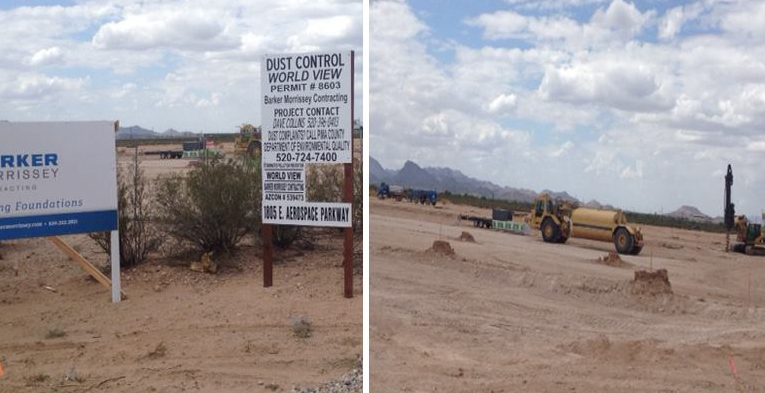
Contractors have begun blading the desert at the World View site.
In the name of economic development, Rio Nuevo and Pima County are poised to dole out $70 million in corporate welfare to two big corporations– $50 million to Caterpillar and $20 million to World View.
Let’s think about this a moment. These two governmental entities are have voted to invest $70 million worth of taxpayer funds in two companies– one company is being lured away from other states to move here and the other is a Tucson company with big ideas and little cash. Is borrowing millions of dollars to give it away sustainable economic development?
According to data from the University of Arizona Eller College, Tucson has one of the highest per capita rates of new patents in the US. We also have new start-up tech companies being nurtured at the UA Tech Park. We have smart scientists + new ideas. Why aren’t we helping entrepreneurs and growing our own local businesses with low-cost loans via a public bank?