The GOP campaign to dismantle the Voting Rights Act of 1965

This coming Thursday, August 6, is the 50th anniversary of the Voting Rights Act of 1965, one of the most consequential pieces of legislation in American history.

Jim Rutenberg of The New York Times in a lengthy exposé, “A Dream Undone,” examines the 50 year GOP campaign to dismantle this landmark piece of legislation. A Dream Undone (excerpts):

Screenshot from 2015-08-01 16:19:52[I]n the American South in 1956, not every would-be black voter was an Air Force officer with the wherewithal to call on the local election board; for decades, most had found it effectively impossible to attain the most elemental rights of citizenship. Only about one-quarter of eligible black voters in the South were registered that year, according to the limited records available. By 1959, when Frye went on to become one of the first black graduates of the University of North Carolina law school, that number had changed little. When Frye became a legal adviser to the students running the antisegregation sit-ins at the Greensboro Woolworth’s in 1960, the number remained roughly the same. And when Frye became a deputy United States attorney in the Kennedy administration, it had grown only slightly. By law, the franchise extended to black voters; in practice, it often did not.

What changed this state of affairs was the passage, 50 years ago this month, of the Voting Rights Act. Signed on Aug. 6, 1965, it was meant to correct “a clear and simple wrong,” as Lyndon Johnson said. “Millions of Americans are denied the right to vote because of their color. This law will ensure them the right to vote.” It eliminated literacy tests and other Jim Crow tactics, and — in a key provision called Section 5 — required North Carolina and six other states with histories of black disenfranchisement to submit any future change in statewide voting law, no matter how small, for approval by federal authorities in Washington. No longer would the states be able to invent clever new ways to suppress the vote. Johnson called the legislation “one of the most monumental laws in the entire history of American freedom,” and not without justification. By 1968, just three years after the Voting Rights Act became law, black registration had increased substantially across the South, to 62 percent. Frye himself became a beneficiary of the act that same year when, after a close election, he became the first black state representative to serve in the North Carolina General Assembly since Reconstruction.
Read more

Closing arguments in North Carolina Voting Rights Act trial

The parties rested their case on Thursday in the Voting Rights Act trial in North Carolina. Closing arguments were made to the Court on Friday morning, and this afternoon. Here are two articles from the Winston-Salem Journal about the close of the trial.

Here is the preview of today’s closing arguments. Closing arguments in voting rights trial set for today:

WillimaBarberBy about noon, a three-week trial on North Carolina’s election law — one of the most sweeping changes in voting practices in the country since the U.S. Supreme Court dealt what critics consider a blow to the Voting Rights Act of 1965 — will end, and the decision on whether the law discriminates against racial minorities will be left up to a federal judge.

Attorneys on both sides officially rested their cases Thursday. State attorneys rested after calling their sixth witness — Brian Neesby, business systems analyst for the State Board of Elections. Plaintiffs, including the N.C. NAACP, called four rebuttal witnesses, including Allan Lichtman, a political science professor at American University, and Charles Stewart III, a political science professor at Massachusetts Institute of Technology. Plaintiffs also called Daphne Ganey, 25, who is from Winston-Salem, and George Bailey, 21, a student at Winston-Salem State University.

U.S. District Judge Thomas Schroeder is presiding over the case and will ultimately make the decision later this year.

Read more

(Update) Plaintiffs rest case in Voting Rights Act trial in North Carolina

I have been a bit remiss in reporting on this case. If you want daily trial updates, you should visit Rick Hasen’s Election Law Blog via the Winston-Salem Journal.

After two weeks of testimony, the Plaintiffs rested their case this week. The state of North Carolina will present its defense beginning Monday. The Winston-Salem Journal reports, Plaintiffs rest case in federal trial over NC voting law:

WillimaBarberAfter two weeks, attorneys representing the N.C. NAACP and other groups rested their case Friday, having called more than 40 witnesses who testified either in court or via video depositions, that North Carolina’s election law is racially discriminatory.

Now, it is the state’s turn to present evidence. Attorneys representing North Carolina and Gov. Pat McCrory called Janet Thornton, an economist, as their first witness. Thomas Farr, one of the attorneys for the state, said they expect to finish presenting evidence by Wednesday.

Read more

Voting Rights Act trial begins in North Carolina

The New York Times has reporter Erik Eckholm in Winston-Salem, NC covering this Voting Right Act trial that opened on Monday. Sides Dispute Basis of North Carolina Voting Laws as Trial Contesting Them Opens:

WillimaBarberA trial over North Carolina’s voting laws opened in a federal courtroom here on Monday, with civil rights groups and the Justice Department arguing that the state had turned back the clock with sweeping changes to its election laws, while the state said the revisions applied equally to all and left its voting rules well within the national mainstream.

“The history of North Carolina is not on trial here,” said Butch Bowers, a lawyer representing Gov. Pat McCrory, in an opening statement. “We will show that there is no discrimination, intentional or otherwise.”

The plaintiffs in the case said the legislation, enacted in 2013, was deliberately drafted to reduce voting by African-Americans. They say the legacy of past racism in North Carolina, including the social and economic disparities between black and white citizens, is deeply relevant.

The contested measures reduced early voting days, ended same-day registration, ended out-of-precinct voting and halted the preregistration of 16- and 17-year-old high school students. These measures had been adopted in the past 15 years to increase voter participation and were disproportionately used by black, Hispanic and younger voters.

The Republican-dominated state legislature adopted the changes only weeks after the United States Supreme Court weakened the Voting Rights Act of 1965 when it ended a requirement that election changes in North Carolina and eight other states with a history of racial discrimination in voting be preapproved by federal officials or courts.

Read more

Voting Rights Act trial to begin in North Carolina

The New York Times today has a front page explainer of the Voting Rights Act trial that gets underway in North Carolina on Monday. Voting Rights Legacy of the ’60s Heads to Court as North Carolina Law Is Tested:

A federal trial opening in Winston-Salem on Monday is meant to determine whether recent, sweeping changes in the state’s election laws discriminate against black voters. These changes were adopted by the Republican-dominated state legislature in 2013, immediately after the United States Supreme Court struck down the heart of the Voting Rights Act of 1965 when it ended a requirement that nine states with histories of discrimination, including North Carolina, get federal approval before altering their election laws.

But the case, as well as one involving a Texas law requiring voters to show a photo ID, could have far wider repercussions, legal experts say — helping to define the scope of voting rights protections across the country in the coming presidential election and beyond.

WillimaBarberThe contested measures in North Carolina include reduced early voting days, an end to same-day registration and an end to a program to preregister high school students. They are a far cry from the violent intimidation and poll taxes of the Jim Crow era. Still, few issues are more highly charged than voting rights in the old Confederate states, where the murder of civil rights workers and the brutal police attack on Alabama marchers galvanized Congress to pass the 1965 act, and the trial is fanning old emotions.

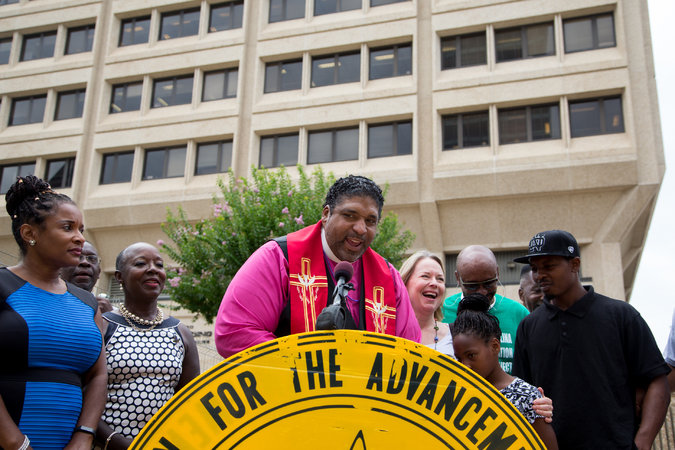
“This is our Selma,” said William J. Barber II, president of the North Carolina N.A.A.C.P. [and Moral Mondays Movement (above)], of the election changes in the state. His group brought the lawsuit, alongside the League of Women Voters, a group of college students and the Department of Justice.

Read more