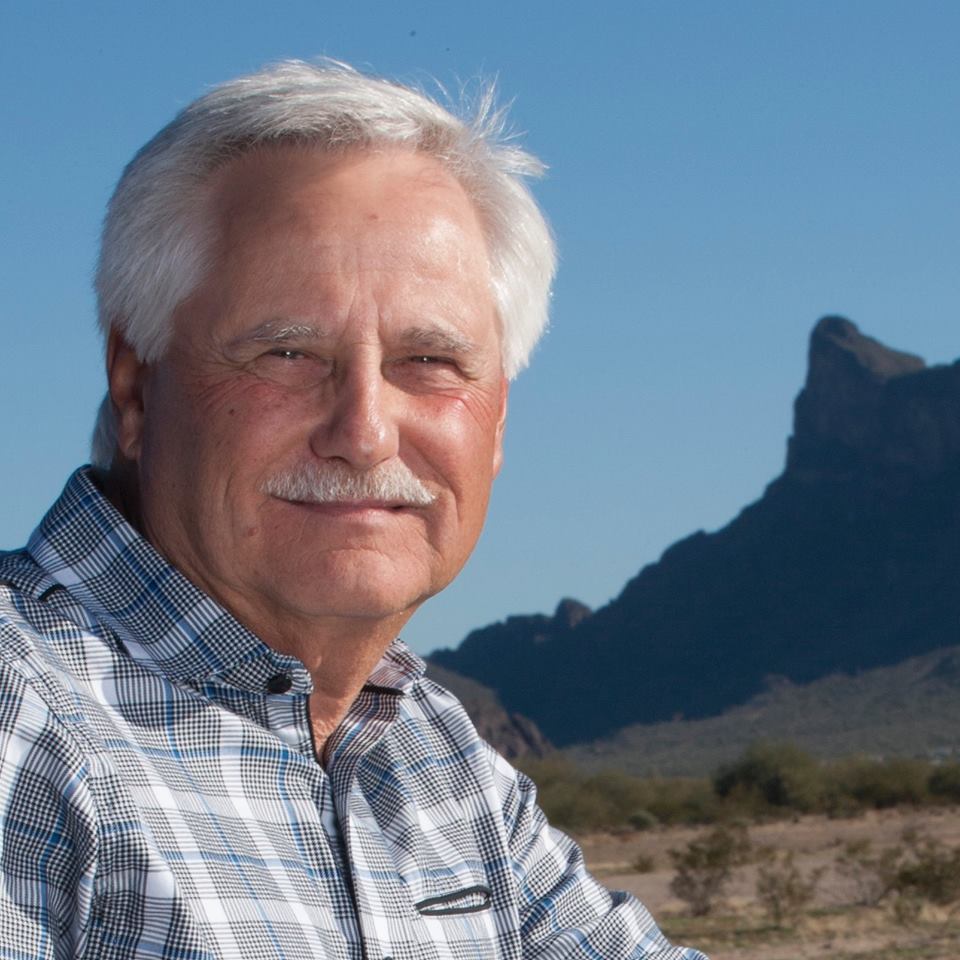
AZ Senate Candidate Ralph Atchue Advocates for Families and Small Businesses of LD 11

Ralph Atchue sees himself as an open-minded problem solver

A former Air Force veteran, union steward, and postmaster from the Chicago area, LD 11 State Senate Clean Elections Candidate Ralph Atchue has launched a grassroots campaign pledging to be a consensus builder.

Atchue advocates a robust forward-looking program that includes investments in public education, comprehensive tax reform, green energy, and transportation innovations like a high-speed rail line from Tucson to Phoenix and later Las Vegas.

Gaining perspective on the competing positions from both labor as a union steward and management as a postmaster general, Atchue sees himself (unlike his opponent for the State Senate, Vince Leach) as a problem solver who can forge inclusive consensus among all stakeholders by bringing them together, discussing the issues, and arriving at compromise solutions that will be agreeable to all parties.

By prioritizing progress, individuals, families, and small businesses, Atchue believes that the residents of LD 11 will be better served that way rather than emphasizing the reactionary and obstructionist interests of the Dark Money groups that Leach subscribes to. (See AZ’s Worst Legislator: Vince Leach, not a Servant of the People in LD 11)

Seeing himself as an open-minded problem solver rather than being tied to any ideological program, Atchue’s campaign looks to attract all parties: Democrats, Independents, and Republicans who want common sense solutions that provide for the greater long-term good of the district. Independents and Republicans have joined Democrats in volunteering to help his campaign as they strive to knock on 2,000 doors a month to bring the candidates inclusive message.

Atchue’s positions on the issues are as follows:

Read more

Oh, SNAP! GOP House Freedom Caucus revolt on farm bill may backfire with additional support for discharge petition on DACA

This morning the Washington Post reported, Spooked by discharge petition, GOP leaders scramble to kill House immigration rebellion:

House Republican leaders made a full-court press Wednesday to forestall a GOP immigration rebellion that they fear could derail their legislative agenda and throw their effort to hold the majority in doubt.

The effort began in a closed-door morning meeting where Majority Leader Kevin McCarthy (R-Calif.) warned that a freewheeling immigration debate could have sharp political consequences. McCarthy to GOP: DACA vote could cost us the House. It continued in the evening, when the leaders of a petition effort that would sidestep were summoned to a room with House Speaker Paul D. Ryan (R-Wis.), McCarthy and three other top leaders.

Their message, according to attendees, was that efforts were underway at the highest levels, including with the White House, to get immigration legislation on the House floor before the midterm elections.

Politico adds, “Two additional Republicans, John Katko of New York and David Trott of Michigan, signed on after McCarthy’s scolding, leaving the group just four signatures shy of their goal.”

“Clearly we have had a positive impact on our leadership and on this institution because this issue is being taken seriously, and people are thinking through how something can be achieved,” said Rep. Carlos Curbelo (R-Fla.), who filed the “discharge petition” that would set up votes on a series of immigration bills.

The House leaders presented no firm plan for action at the meeting, and the discharge petition effort will continue, Curbelo and others said afterward.

Read more

9th Circuit Court of Appeals hears DACA appeal while new arrivals face family-separation policy

A three-judge panel with the U.S. Court of Appeals for the 9th Circuit on Tuesday questioned the government’s rationale for terminating the DACA program that offered a reprieve from deportation to immigrants who came to the United States illegally as children, with one judge inquiring whether officials had yet considered re-justifying the decision to make it more legally sound. Appeals court hears arguments on DACA — but offers few clues on how it might rule:

The 9th Circuit is the first appellate court to hear oral arguments on whether the Trump administration’s decision to end the Deferred Action for Childhood Arrivals program, commonly known as DACA, can pass legal muster.

The judges — two appointed by President Barack Obama and one by President Bill Clinton — asked skeptical questions of both sides, and it was difficult to determine how they might rule.

The judges inquired about whether the judiciary could rightly second-guess what the government characterizes as an exercise of prosecutorial discretion, and whether the government might — as one lower court judge suggested — consider providing more solid legal reasoning for coming to the decision it did. They also asked about whether the government might have violated the due-process rights of DACA recipients whose lives could be upended.

A federal judge in San Francisco — weighing bids to save DACA from the states of California, Maine, Maryland and Minnesota; California’s university system; and individual DACA recipients — had blocked the administration from ending the program, at least temporarily. The ruling was largely based on the judge’s conclusion that the decision to end it was arbitrary and based on flawed legal reasoning.

Read more

poverty map

‘Economically forgotten’ have much in common with America’s poor

Axios.com has an Exclusive: 40% in U.S. can’t afford middle-class basics:

Screen Shot 2018-05-16 at 6.19.16 AM

Data: United Way; Chart: Chris Canipe/Axios

At a time of rock-bottom joblessness, high corporate profits and a booming stock market, more than 40% of U.S. households cannot pay the basics of a middle-class lifestyle — rent, transportation, child care and a cellphone, according to a new study.

Quick take: The study, conducted by United Way, found a wide band of working U.S. households that live above the official poverty line, but below the cost of paying ordinary expenses. Based on 2016 data, there were 34.7 million households in that group — double the 16.1 million that are in actual poverty, project director Stephanie Hoopes tells Axios.

Why it matters: For two years, U.S. politics has been dominated by the anger and resentment of a self-identified “forgotten” class, some left behind economically and others threatened by changes to their way of life.

  • The United Way study, to be released publicly Thursday, suggests that the economically forgotten are a far bigger group than many studies assume — and, according to Hoopes, appear to be growing larger despite the improving economy.
  • The study dubs that middle group between poverty and the middle class “ALICE” families, for Asset-limited, Income-constrained, Employed. (The map above, by Axios’ Chris Canipe, depicts that state-by-state population in dark brown.)
  • These are households with adults who are working but earning too little — 66% of Americans earn less than $20 an hour, or about $40,000 a year if they are working full time.

When you add them together with the people living in poverty, you get 51 million households. “It’s a magnitude of financial hardship that we haven’t been able to capture until now,” Hoopes said.

By the numbers: Using 2016 data collected from the states, the study found that North Dakota has the smallest population between poverty and middle class, at 32% of its households. The largest is 49%, in California, Hawaii and New Mexico. “49% is shocking. 32% is also shocking,” Hoopes said.

Read more

A Tale of Two Realities

The relationship between Israel and Palestine is truly a tale of two realities where, over the decades,  people on both sides had their lives prematurely taken from their loved ones. Strong leadership committed to peace and prosperity on both sides for both sides is needed to resolve this dispute as well as the United States leadership returning to the role of Honest Broker instead of its recent overt pro-Israel posture.

On one side you have the Israelis who represent the only vibrant democracy in the region. In this country, everyone, including the Arabs, has equal rights and representation in the Israelis Parliament, the Knesset.

However, the Israelis have a problem trusting their neighbors for good reason. Before it achieved nationhood, its mandate to establish a homeland in Palestine was reduced by roughly two thirds when the British, in the first land for peace deal, called the Palestinian Territories east of the Jordan River Trans Jordan (later just Jordan) and gave it to the Arabs. Not satisfied with two-thirds of the land, the Arabs in the Jewish third of Palestine wanted that too. Giving into Arab protests, the British decided to divide that parcel up in a similar way that they haphazardly partitioned India and Pakistan (whose eastern boundaries would become Bangladesh). This arrangement was doomed to cause future conflict as the future states of Israel and Palestine were born. In the war for independence, Israel, despite the odds, survived increasing its territorial holdings on lands Palestinians abandoned at the leading Arab elites request (thinking they would return after Israel was defeated) or when the Israelis ejected them.  Whatever was left was scooped up by Jordan and Egypt in the occupation nobody seems to remember in the history books. In the later Six Day War in 1967, Israel acquired the remainder of Jerusalem, the West Bank, the Golan Heights, Gaza, and the Sinai Peninsula. Israel offered to return all the captured lands in exchange for peace and the Arab countries rejected the overture. Only later when Egypt made peace with Israel in 1979 was the Sinai returned. Gaza was also offered back to Egypt but the Egyptians did not want the headache. Jordan probably felt the same way when it did not insist on the return of the West Bank when it made its peace treaty with Israel in 1994.

Read more