Now about that dual election system in Kansas and Arizona

NoVoteIt was just short of a year ago that I told you about the lawsuit filed by the ACLU and League of Women Voters against Kansas Secretary of State Kris Kobach in Kansas state court, Belenky v. Kobach, seeking an injunction against the “dual election system” established by Kobach to disenfranchise citizens of their right to vote in state and local elections if they had registered to vote using the federal voter registration form (Arizona Secretary of State Ken “Birther” Bennett established a similar dual election system in Arizona).

Because there was a parallel case in another court, Kobach v. U.S. Election Assistance Commission in the Tenth Circuit Court of Appeals, and the closeness of the primary election date, Shawnee County District Court Judge Franklin Theis denied the injunction. The judge did not rule on the merits of the case. Kansas judge approves dual election system in Kansas. Both Kansas and Arizona conducted dual elections in 2014 based upon the voter registration form that voters used to register to vote.

A unanimous panel of the 10th Circuit Court of Appeals ruled in favor of the Election Assistance Commission in Kobach v. U.S. Election Assistance Commission. On Monday, the U.S. Supreme Court denied the appeal from this order without comment, a surprising turn of events given that Justice Antonin Scalia suggested the convoluted legal process to Kansas and Arizona in his earlier Supreme Court opinion in Arizona v. The Inter Tribal Council of Arizona, Inc.

So what is the status of Belenky v. Kobach (2013-CV-001331) in Kansas state court?

Read more

Michele Reagan should look to Montana’s ‘dark money’ disclosure law

Last year when Secretary of State Michele Reagan was in the Senate and running for higher office, she was pushing her so-called “dark money” disclosure bill. I explained at the time that Sen. Michele Reagan’s dark money disclosure bill will accomplish little:

MicheleReaganSen. Reagan’s bill “to include the names of the three largest contributors” will only result, at best, in the disclosure of “Kochtopus” alphabet soup 501(c) organizations — Russian nesting dolls — set up to hide the true identity of the actual contributors, who are millionaire and billionaire plutocrats. It is not a serious attempt to regulate the dark money organizations corrupting our elections. It is pure posturing by her for her campaign to become Arizona’s next Secretary of State. We can do better than Michele Reagan, the co-author of the GOP Voter Suppression Act, HB 2305.

Nevertheless, opinion makers like The Arizona Republic’s Laurie Roberts — whom I believe is genuinely concerned about the corrupting influence of “dark money” in Arizona politics — truly madly deeply wanted to believe that Michele Reagan was also genuinely concerned about the corrupting influence of “dark money” in Arizona politics. Like Peter Pan, Ms. Roberts assured readers “If you believe, clap your hands; don’t let [“dark money” regulation] die.”

Only since her election as Secretary of State, Michele Reagan has failed and/or refused to take any action against “dark money” groups. Quite the opposite, she even intervened on behalf of one “dark money” group in one lawsuit. Even Peter Pan Laurie Roberts is now disillusioned. Has Michele Reagan gone over to Arizona’s dark side? Hindsight is 20/20. The trick is knowing when you are being played, and not encouraging others to fall for it.

Read more

The public wants the influence of money out of politics, but is cynical that anything can be done about it

The New York Times this week reports a new Poll Shows Americans Favor an Overhaul of Campaign Financing:

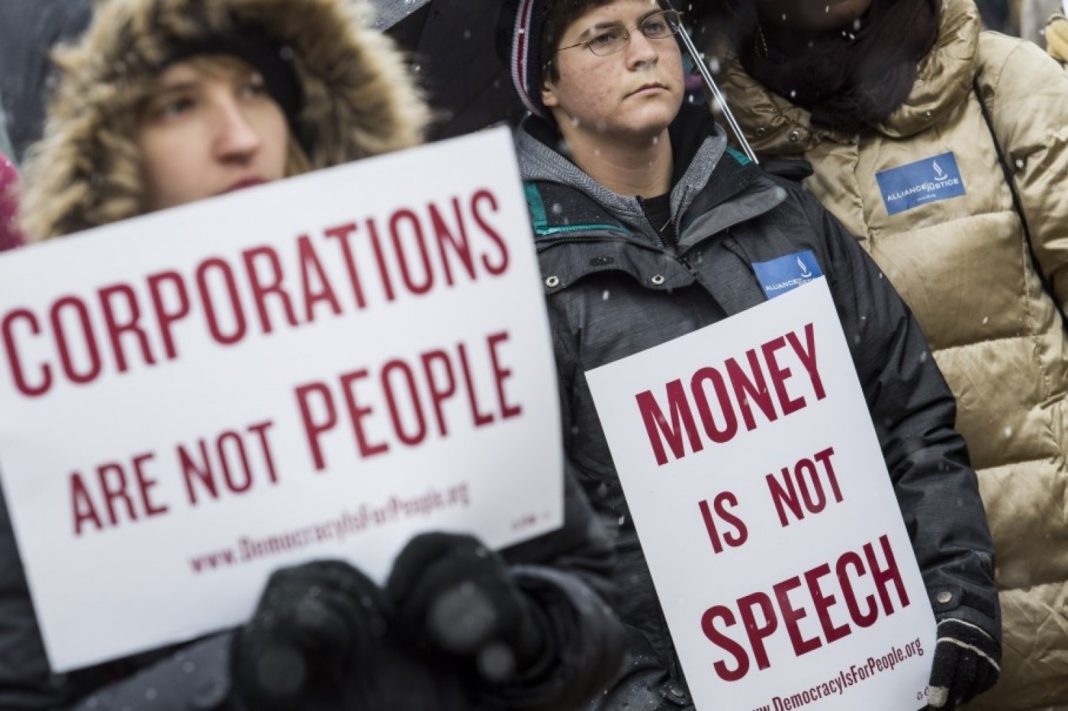
MoneySpeechAmericans of both parties fundamentally reject the regime of untrammeled money in elections made possible by the Supreme Court’s Citizens United ruling and other court decisions and now favor a sweeping overhaul of how political campaigns are financed, according to a New York Times/CBS News poll.

The findings reveal deep support among Republicans and Democrats alike for new measures to restrict the influence of wealthy givers, including limiting the amount of money that can be spent by “super PACs” and forcing more public disclosure on organizations now permitted to intervene in elections without disclosing the names of their donors.

And by a significant margin, they reject the argument that underpins close to four decades of Supreme Court jurisprudence on campaign finance: that political money is a form of speech protected by the First Amendment. Even self-identified Republicans are evenly split on the question.

Read more

Anti-immigrant groups file amicus briefs in Kobach v. U.S. Election Assistance Commission

At the end of March I posted that Kobach v. US Election Assistance Commission appealed to U.S. Supreme Court:

Last November, the 10th Circuit Court of Appeals struck down proof-of-citizenship requirement for National Voter Registration Form:

NoVoteA panel of the 10th Circuit Court of Appeals on Friday, in a unanimous decision, struck down Arizona’s Prop. 200 (2004) proof-of-citizenship requirement for voter registration and a similar provision of Kansas law in Kobach v. U.S. Election Assistance Commission (Nos. 14-3062 and 14-3072). Specifically, this case concerns whether Arizona and Kansas have to accept the federal National Voter Registration Form without additional proof of citizenship. The Arizona Voter Registration Form proof-of-citizenship requirement has previously been upheld by the Courts.

Read the Opinion Here (.pdf).

[UPDATE: The Federal Voter Registration Form requires the voter to swear/affirm that they are a U.S. citizen and that they meet the eligibility requirements of their state “under penalty of perjury. If I have provided false information, I may be fined, imprisoned or (if not a U.S. citizen) deported from or refused entry to the United States.”]

The Wichita Eagle reports, Kris Kobach asks U.S. Supreme Court to restore his proof-of-citizenship law:

Kansas Secretary of State Kris Kobach is asking the U.S. Supreme Court to overturn an appeals court decision and restore a state law he wrote requiring proof-of-citizenship documents to register to vote.

Kobach wants the Supreme Court to undo the November decision by the Denver-based 10th Circuit Court of Appeal, in a case pitting Kansas and Arizona against the federal Election Assistance Commission and a bevy of voting rights groups.

This case was docketed at the U.S. Supreme Court on March 24.  Docket for 14-1164. (h/t SCOTUSblog).

Read more

Time for another referendum (citizens veto) of GOP voter suppression – HB 2407

ArizonaIn 2013, Arizonans rose up in righteous indignation against the GOP Voter Suppression Act, HB 2305, and qualified a citizens referendum (citizens veto) for the 2014 ballot. In 2014, Tea-Publicans repealed HB 2305 before voters could have the opportunity to vote on it and to make the rejection of the legislature’s action permanent under the Voter protection Act, itself a form of voter suppression.

In 2015, Tea-Publicans returned with a piecemeal attempt to enact HB 2305 as a package of separate bills to make it harder for the citizens of Arizona to pursue a citizens referendum of their voter suppression efforts. Some of those bills didn’t make it (they will be back next year) and others did.

One GOP Voter Suppression bill that passed and that has now been signed by Gov. Doug Ducey is HB 2407 (.pdf), which now makes it much more difficult and expensive for Arizona citizens to exercise their constitutional right to citizens initiatives, referendums and recall. Tea-Publicans are now imposing the “strict compliance” with statutory requirements for referendums to initiatives and recalls as well.

What this means is that petitions can be disqualified for hyper-technical deficiencies such as typographical errors, typeset, line spacing and margins, a missing serial number, incomplete voter information (such as date of signature), an error in the affidavit of signature gatherer or notary public, etc. Despite your best good faith efforts to comply with all the rules, the Secretary of State is now empowered to disqualify petition sheets for such hyper-technical deficiencies.

Read more