The constitutional crisis coming after Election Day

This is really information voters should have available before Election Day in order to make an informed decision, but due to long-standing Justice Department custom, prosecutors are generally advised to avoid public disclosure of investigative steps involving a candidate for office or related to election matters within 60 days of an election.

The Justice Department’s Inspector General recently noted in a report about the 2016 election: “The 60-Day Rule is not written or described in any Department policy or regulation. Nevertheless, high-ranking Department and FBI officials acknowledged the existence of a general practice that informs Department decisions.” So here we are.

Bloomberg News reports today, Mueller Ready to Deliver Key Findings in His Trump Probe, Sources Say:

Special Counsel Robert Mueller is expected to issue findings on core aspects of his Russia probe soon after the November midterm elections as he faces intensifying pressure to produce more indictments or shut down his investigation, according to two U.S. officials.

Specifically, Mueller is close to rendering judgment on two of the most explosive aspects of his inquiry: whether there were clear incidents of collusion between Russia and Donald Trump’s 2016 campaign, and whether the president took any actions that constitute obstruction of justice, according to one of the officials, who asked not to be identified speaking about the investigation.

That doesn’t necessarily mean Mueller’s findings would be made public if he doesn’t secure unsealed indictments. The regulations governing Mueller’s probe stipulate that he can present his findings only to his boss, who is currently Deputy Attorney General Rod Rosenstein. The regulations give a special counsel’s supervisor some discretion in deciding what is relayed to Congress and what is publicly released.

The question of timing is critical. Mueller’s work won’t be concluded ahead of the Nov. 6 midterm elections, when Democrats hope to take control of the House and end Trump’s one-party hold on Washington.

Read more

Lots of good reporting on the Russia investigation

While Special Counsel Robert Mueller continues working quietly behind the scenes, there have been several excellent pieces of investigative journalism in recent days following leads on the Russian collusion thread of the investigation. These are lengthy investigative reports that I will not attempt to parse out here.

Luckily, Andrew Prokop at Vox.com has already posted an excellent summary. The past 48 hours in Mueller investigation news, explained (paragraphs reordered for clarity):

New reports over the past two days have brought increased attention to three long-simmering subplots in special counsel Robert Mueller’s Russia investigation.

First, the Wall Street Journal revealed new details about GOP operative Peter W. Smith’s quest to obtain Hillary Clinton’s emails from Russian hackers during the 2016 campaign — including that he raised at least $100,000 for the effort and then pitched in $50,000 of his own money. (Smith was found dead last year, and local authorities ruled his death a suicide.)

Peter W. Smith: what happened when he sought Hillary Clinton’s emails from Russian hackers?

What we already knew: During the 2016 campaign, 80-year-old GOP operative Peter W. Smith recruited a team to try to obtain Hillary Clinton’s 33,000 deleted emails from “dark web” hackers — including hackers he thought were “probably around the Russian government.” It’s not clear if Smith had any success, but we know he tried because he freely admitted all this to reporter Shane Harris in May 2017.

Read more

A ‘rigged’ FBI investigation in the Kavanaugh coverup (Updated)

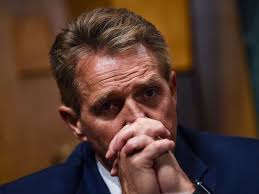
Arizona Senator Jeff Flake called for a thorough FBI background investigation while speaking at an event in Boston. “It does no good to have an investigation that gives us more cover, for example,” he said. “We actually have find out what we can find out.”

While the Twitter-troll-in-chief lied his ass off in tweets and press statements that the FBI could follow any lead and speak to any witness, White House legal counsel Don McGahn, a longtime friend of Judge Kavanaugh’s, made certain the background investigation would be severely restricted. To borrow Trump’s favorite phrase, the FBI background investigation was “rigged.”

Bloomberg News reports that the FBI did not even interview the principals involved. FBI Lacks White House Approval to Talk to Kavanaugh and Ford.

NBC News reports that the FBI has not contacted dozens of potential sources in Kavanaugh investigation:

More than 40 people with potential information into the sexual misconduct allegations against Supreme Court nominee Brett Kavanaugh have not been contacted by the FBI, according to multiple sources that include friends of both the nominee and his accusers.

[S]ources close to the investigation, as well as a number of people who know those involved, say the FBI has not contacted dozens of potential corroborators or character witnesses.

More than 20 individuals who know either Kavanaugh or Ramirez, who has accused the nominee of exposing himself to her while the two attended Yale University, have not heard from the FBI despite attempts to contact investigators, including Kavanaugh’s roommate at the time and a former close Ramirez friend.

Read more

Protecting the Special Counsel from a ‘slow-motion Saturday night massacre’

Neal Katyal, the Justice Department lawyer who wrote the rule book for the office of Special Counsel, offers his advice to what may be the next step in the “slow-motion Saturday night massacre” on Thursday, when Deputy Attorney General Rod Rosenstein meets with President Trump. How Rosenstein can protect the Mueller investigation — even if he’s fired:

Thursday’s meeting between Deputy Attorney General Rod J. Rosenstein and President Trump carries the highest of stakes: Besides special counsel Robert S. Mueller III, Rosenstein is the most important person involved in the investigation of the Trump administration’s possible ties to Russian interference in the 2016 election. That is by design. The special counsel regulations, which I had the privilege of drafting in 1999, make Rosenstein what corporate mavens call a “key man.” If Rosenstein is removed, Trump could very easily cripple the investigation.

The president knows it. Trump’s attorney, Jay Sekulow, this week called for Solicitor General Noel Francisco, who would probably replace Rosenstein in overseeing Mueller’s work if Rosenstein leaves office, to “pause” the investigation and to take “a step back.”

Which is why Rosenstein should prepare for Thursday by sending Congress, through appropriate channels, a description of the evidence of wrongdoing Mueller has already turned up. There’s no way to know what a meeting with the volatile president might bring. And the search for the truth might depend on what steps Rosenstein takes beforehand.

Read more

It is time for Congress to act to protect the Special Counsel investigation

Axios reported Monday morning that Deputy Attorney General Rod Rosenstein  “has verbally offered to resign to White House Chief of Staff John Kelly, according to a source close to Rosenstein, but as of now, it’s unclear whether his resignation has been accepted.”

Well, that set off a cable news frenzy, so I hear. Headlines blared that Rosenstein had been summoned to the White House where he ws expected to resign or be fired. Rosenstein was filmed arriving and departing the White House.

It now appears that all the excitement was a bit premature: Rosenstein will meet with Donald Trump on Thursday to discuss his future at DOJ.

This all has to do with a New York Times report from Friday, citing sources who were not participants in the room at the time of the conversations reported. Rod Rosenstein Suggested Secretly Recording Trump and Discussed 25th Amendment:

The deputy attorney general, Rod J. Rosenstein, suggested last year that he secretly record President Trump in the White House to expose the chaos consuming the administration, and he discussed recruiting cabinet members to invoke the 25th Amendment to remove Mr. Trump from office for being unfit.

* * *

Mr. Rosenstein made the remarks about secretly recording Mr. Trump and about the 25th Amendment in meetings and conversations with other Justice Department and F.B.I. officials. Several people described the episodes in interviews over the past several months, insisting on anonymity to discuss internal deliberations. The people were briefed either on the events themselves or on memos written by F.B.I. officials, including Andrew G. McCabe, then the acting bureau director, that documented Mr. Rosenstein’s actions and comments.

The Washington Post, which cites participants who were in the room for the conversations says the remark was sarcastic. NBC News also had a competing account, which includes Rosenstein “joking when he discussed wearing a wire.”

Read more