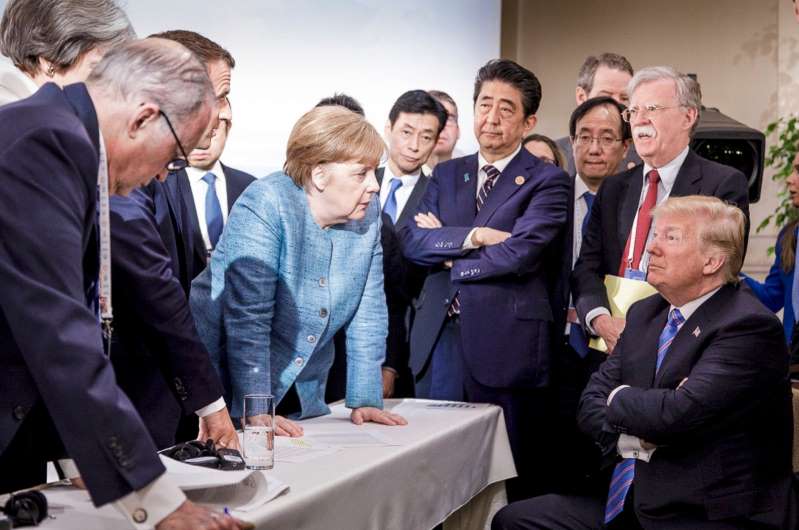
Trump’s rose goes to appellate court judge Brett M. Kavanaugh

“Dear Leader” in his reality TV show “Supreme Court Nominee” rose ceremony gave his rose to a white male Washington “swamp” insider,  District of Columbia Court of Appeals Judge Brett M. Kavanaugh, a man who is on record having said the words that Donald Trump most wants to hear: in 2009 Kavanaugh said indicting a sitting president “would ill serve the public interest, especially in times of financial or national-security crisis,” and later wrote that “Congress should pass laws that would protect a president from civil and criminal lawsuits until they are out of office.”

In other words, Trump is putting his thumb on the scales of justice to protect himself from the Special Counsel’s Russia investigation, an obvious conflict of interest that undermines the legitimacy of the Supreme Court. Has Trump extracted a loyalty oath from Judge Kavanaugh?

No senator should enable this. Period.

The Los Angeles Times has a good backgrounder on Judge Kavanagh. Brett Kavanaugh, a Washington veteran, has inside track to a Supreme Court nomination:

Judge Brett M. Kavanaugh, a Washington veteran with a reliably conservative record, has the inside track for the Supreme Court nomination to be announced Monday evening by President Trump.

The federal appeals court judge, 53, has lived and worked nearly his entire career in Washington, including in past Republican administrations, and he is well-known and respected by the conservative lawyers in the Federalist Society and in the White House counsel’s office.

But some activists on the right have rallied against him, citing his close ties to the Republican establishment and several court rulings that they believe did not go far enough in a conservative direction. [Will they fall silent now?]

Kavanaugh is a graduate of Yale University and Yale Law School, making him the only finalist for the nomination with an Ivy League education. Last year, Trump said he was drawn to his first appointee, Justice Neil M. Gorsuch, because he had degrees from Columbia, Harvard and Oxford.

Read more

The Roberts Court: a new Gilded Age and a return to the long-discredited Lochner Era

Jedediah Purdy, professor of law at Duke, recently wrote at the New York Times, The Roberts Court Protects the Powerful for a New Gilded Age:

Faith in courts runs deep in the American liberal imagination. Remembering Brown v. Board of Education, Roe v. Wade and the recent marriage-equality decisions, we keep hoping that wise and fair-minded judges will protect the vulnerable and lead the country toward justice.

Recent decisions upholding President Trump’s travel ban and Texas’ racially skewed voting districts are body blows to this optimism. They are unhappy reminders that for much of American history, the Supreme Court has been a deeply conservative institution, preserving racial hierarchy and the prerogatives of employers.

When it comes to economic inequality, today’s Supreme Court is not only failing to help but is also aggressively making itself part of the problem in a time when inequality and insecurity are damaging the country and endangering our democracy.

Under Chief Justice John Roberts, the court has consistently issued bold, partisan decisions that have been terrible for working people. Janus v. American Federation of State, County and Municipal Employees, was one of them.

Just hours after that decision, Justice Anthony Kennedy announced his retirement. With this “swing” vote gone, Chief Justice Roberts is now likely to take even more control over the direction of issues related to economic inequality — a direction that is earning him a legacy as chief justice of bosses, not workers.

Read more

Federal courts deliver a pounding to the Trump administration’s immigration policies (updated)

At the end of June, Health and Human Services Secretary Alex Azar, who has jurisdiction over the child immigrants being separated from their parents and held in detention centers, testified before the Senate Finance Committee that he can find separated migrant kids ‘within seconds’:

Health and Human Services Secretary Alex Azar said Tuesday he could find any child separated from their migrant parents “within seconds.”

“There is no reason why any parent would not know where their child is located,” Azar told the Senate Finance Committee. “I could at the stroke of keystrokes … within seconds could find any child within our care for any parent.”

Azar pushed back on reports that parents and children forcibly separated at the Mexican border under President Trump’s “zero tolerance” policy can’t find each other. He said that by using his computer “portal” through the Office of Refugee Resettlement, he could easily locate the kids.

Azar’s testimony was under oath. The Senate must now consider charging him with perjury or lying to Congress.

Late last week, U.S. District Judge Dana Sabraw in Ms. L v. ICE, Case No.: 18cv0428 DMS (MDD), U.S. District Court Southern District of California, denied the Trump administration’s request to extend the deadline to reunite families that had been separated at the border — not so simple as “the stroke of keystrokes … within seconds could find any child within our care for any parent,” is it? Judge insists timeline be met to reunite children at border:

A judge insisted on Friday the Trump administration stick to a deadline to reunite children separated from their parents at the border, instead acknowledging that more time may be justified only in specific cases.

U.S. District Judge Dana Sabraw ordered the administration to share a list of the 101 children with the American Civil Liberties Union, which successfully sued to force the reunions, by Saturday afternoon. The two sides will try to determine over the weekend which cases merit a delay in an effort to present a unified front in court on Monday morning.

“The government must reunite them,” the judge said. “It must comply with the time frame unless there is an articulable reason.”

The administration said it needed more time to reunite 101 children under 5 years old to ensure the children’s safety and to confirm their parental relationships.

Read more

The economic disruption of the technology tsunami has political repercussions

In an occasional series I do on the economic disruption caused by the technology tsunami, see The technology tsunami is replacing ‘good paying jobs’ that are not coming back, and (Update) Public policy is failing to address the economic disruption from rapidly advancing technology for example, I look at the effects of automation, computerization, robotics and artificial intelligence on jobs and the economy.

But technology also has repercussions on our politics, as technological innovations have had in the past throughout history. Axios.com, which does a good job of reporting on the technology tsunami, reports on new research today. Robots may have given Trump an edge in 2016:

For two years, historians, economists and others have pondered whether western leaders, facing a growing populist challenge, must prepare for an even greater temblor resembling the French Revolution or 1930s fascism.

The big picture: In a new paper in the Oxford Review of Economist Policy, U.K. economist Carl Frey and two co-authors argue that the 2016 U.S. presidential election — and the effects of industrial automation during the decades before — may be a signal of worse to come.

Read more

An ‘ugly American’ abroad: NATO, the Queen, and pal Putin, oh my!

The NATO Summit will be held July 11-12, 2018 in Brussels, Belgium. As Summit Nears, NATO Allies Have One Main Worry: Trump:

[T]here is one wild card: President Trump.

Nobody knows which president will show up — the truculent one railing about inadequate military spending by the allies or the boastful one taking credit for recent spending increases.

Either way, NATO members say they fear that all the preparation and the desire to show solidarity in the face of a new Russian threat will be overshadowed, if not undone, by a divisive encounter followed by Mr. Trump’s prospective summit meeting with the Russian president, Vladimir V. Putin.

The European allies are deeply worried that they will confront the Trump who was on display at the meeting in June in Canada of the seven major economies, known as the Group of 7, or G-7. Those in the room described him as angry, mocking, wandering and rude, especially to the host, Canada’s prime minister, Justin Trudeau, and to Chancellor Angela Merkel of Germany.

There, Mr. Trump focused on two of his fixed ideas: the unfairness of trade with European allies and their inadequate level of military spending.

The Trump administration regards Western European nations as free-riders on an American-funded, postwar peace that enabled them to build lavish social benefit systems because they spent so little on defending themselves. He has also made clear that he thinks the European Union, as a trading bloc, has taken advantage of American generosity.

European and some American officials say they dread the same pattern — a noisy, divisive NATO summit, damaging deterrence, followed by a chummy meeting with a dictator, in this case Mr. Putin, whose long-term goals are to destabilize the European Union, undermine NATO and restore Russian influence over Eastern Europe, the Baltic States and the Balkans.

Read more